The New Balance Playbook Reverse Engineered
This week, I wanted to inspire you with a change of pace, offering you the modern-day brand turnaround story: New Balance. NB managed to turn a “suburban dad shoe” company into a $10 billion cultural driving force.
We’re going under the hood of how they did it and, more importantly, what it means for you as a CMO or VP of Marketing inside a complex, political, often distracted organisation.
The New Balance Playbook Reverse Engineered
This is not a trainer/sneaker story. It’s a playbook for using brand, operations, and ambition to shape both your business and your customers’ opinions – even if you’re currently seen as the “uncool”, “legacy”, or “stuck” brand in your category.
1. Start with a Single Muse, Not a Broad “Target Market”
Before New Balance could become culturally relevant, it had to get radically specific about who it was talking to.
In 2019, leadership “quieted the noise” and centred everything around one target consumer: the 18–34-year-old “global independent”. This wasn’t a persona slide; it was a forcing function.
It gave product, brand, and commercial teams permission to stop trying to serve everyone. Decisions became simpler:
Does this campaign speak to the global independent?
Does this product look and feel like something they would wear?
Does this collaboration earn us credibility with them?
For you as a CMO, this is the first uncomfortable truth: if your teams are trying to hit every demographic and every channel, they’re not being strategic – they’re operating out of fear.
Narrowing the muse is how you create edge. Edge creates talkability. Talkability creates disproportionate growth.
2. Action Plans, Not White Papers
When COVID hit and revenue dropped to around $3.3 billion, New Balance didn’t respond with theoretical rewrites of the five-year strategy. CEO Joe Preston asked for something much less glamorous and far more powerful: action plans.
Cross-functional teams were given three things most organisations talk about but rarely operationalise – the 3 A’s: Accountability, Authority, and Autonomy.
The agenda narrowed to the few topics that mattered, and timelines were tight.
From a Marketing perspective, this is the difference between “brand guardianship” and “brand leadership”. This is what I call brand coaching vs brand policing. Why? Policing always leads to resentment within businesses.
Brand guardianship protects assets.
Brand leadership moves markets.
In a crisis – and for many categories, the post-pandemic years have been a rolling crisis the job of the CMO is to shrink the scope, sharpen the priorities, and force decisions into motion:
Fewer decks. More decisions.
Fewer “options”. More clear trade-offs.
Fewer committees. More accountable owners.
New Balance used wartime constraints to accelerate a decade-long repositioning project. Most brands used wartime as an excuse to pause, delay, or over-analyse. That’s a choice.
3. The Strategic Pivot: Owning the “Uncool Truth”
The heart of the New Balance turnaround is brutally simple: they stopped trying to escape who they were.
For years, the brand carried the “dad shoe” stereotype – chunky, practical commuter shoes.
Instead of pivoting into hype-driven reinvention and abandoning that heritage, they did something braver: they leaned into it.
They treated the “uncool truth” as the starting point:
Known for comfort and orthopaedic credibility.
Core silhouettes were chunky, grey, functional.
Associated with lawn-mowing, not front-row fashion.
Rather than running from that, they asked: What if this is the moat?
Over a 10–15 year period, they reframed their “dad brand” into “heritage performance” and then into “ironically cool” premium fashion.
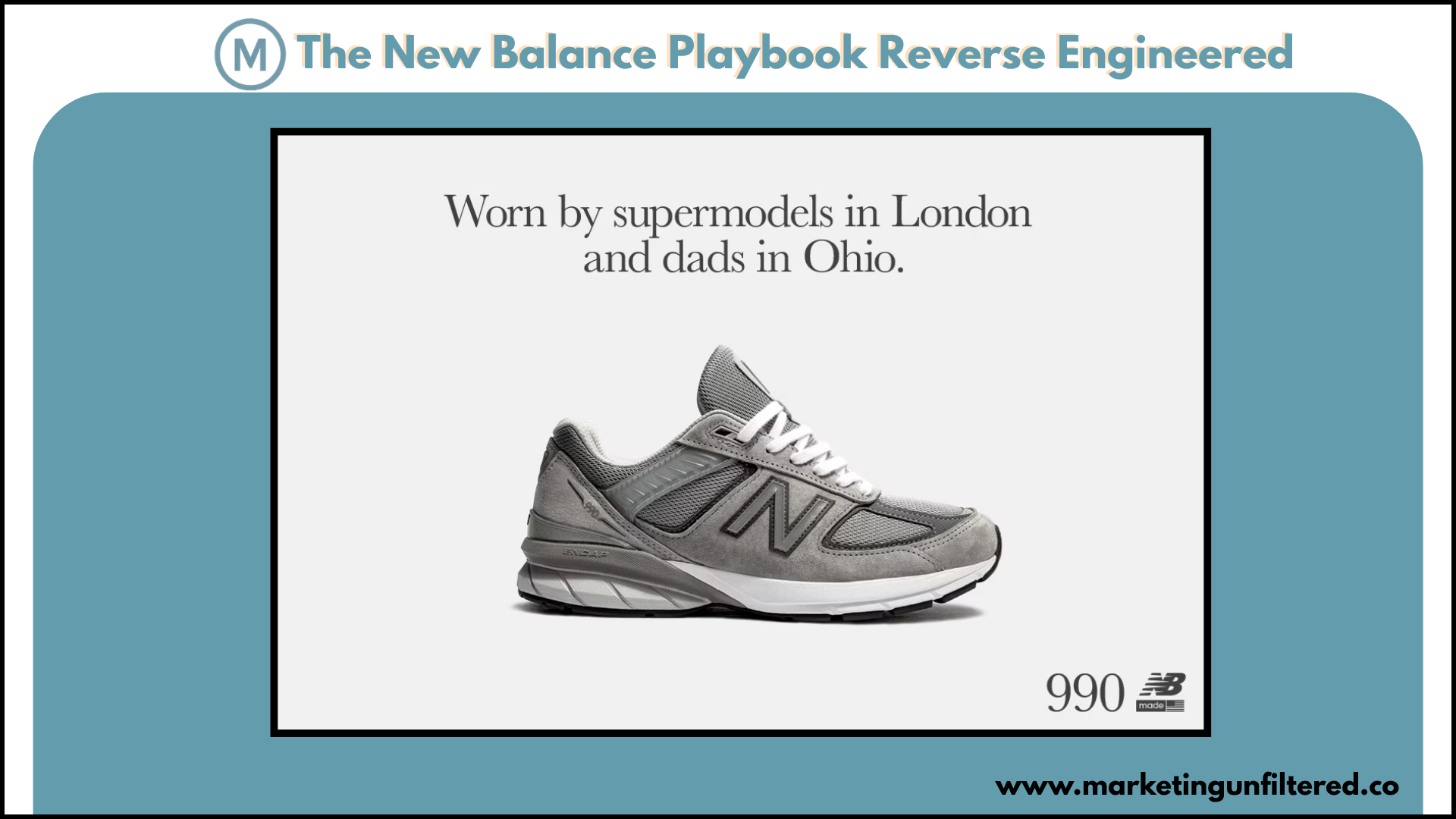
The now iconic 990 went from suburban cliché to high-fashion staple, not through gimmicks but through constraint: tighter shapes, elevated materials, more considered colour stories.
^ Image Source Pinterest
Authenticity became the growth lever.
When the market swung towards normcore, comfort, and “quiet luxury”, New Balance wasn’t chasing the trend; it was ready for it.
For CMOs, the lesson is clear: there is almost always an “unfashionable” or “uncomfortable” truth about your brand. You can fight it (and lose), or you can embrace it and use it as the anchor for something distinctive and enduring.
4. Collaboration Architecture: From Logo Slaps to Cultural Brokers
If authenticity was the foundation, collaborations were NBs bridge.
New Balance didn’t treat collaborations as hype releases to juice quarterly demand. They treated them as a translation layer between heritage and modern culture.
Instead of stacking logos with anyone who’d answer the phone, they built a “cultural broker” model:
Partners like Stone Island, Aimé Leon Dore and Joe Freshgoods weren’t asked to decorate existing products; they were invited to reinterpret them.
Storytelling was rooted in specific geographies – Washington D.C., Chicago, London – not just another brand with a generic idea of “urban culture”.
The design language cleaned up the dad shoe aesthetic for luxury and streetwear while keeping the core DNA.
The outcomes were measurable: collaboration-driven media impressions spiked; New Balance became one of the fastest-growing brands on StockX (secondary markets are signal for cultural change); and organic endorsements from figures like Rihanna and Timothée Chalamet reframed the 990 as part of the “off-duty” uniform of modern icons.
The point for you: collaborations are not just another tick box exercise or a substitute tactic. They are an amplifier of long-term strategy.
If you haven’t first defined your uncool truth and your muse, collaborations will be noisy, inconsistent, and forgettable. With those in place, they become compounding assets that pull your brand into new circles of relevance.
5. The Rising Star Model: The Brand as Co‑Protagonist
New Balance’s approach to talent is another deliberate departure from category norms.
Where many sports brands overspend on established superstars – renting borrowed interest – New Balance backs ascending talent: pre-peak, high-upside, aligned with the challenger narrative.
Coco Gauff is the flagship example. Signed early, supported consistently, and positioned not just as a sponsored athlete but as a co-author of the brand story through platforms like “Call Me Coco” and “We Got Now”.
Across sports, the pattern repeats:
Basketball: a guard-heavy roster and quiet superstars like Kawhi Leonard to underscore performance legitimacy.
Football: young, culturally resonant players such as Bukayo Saka and Arsenal team mate Eberechi Eze (seen below with chess grand master Magnus Carlsen) to unlock global youth relevance.
Olympic and women’s sport: athletes like Sydney McLaughlin-Levrone to anchor a serious performance narrative.
Cultural ambassadors: Jaden Smith and Jack Harlow bridged sport, music, and culture.
The cost base is smarter. The brand equity is often much deeper. The narrative is coherent: New Balance stands with rising, hard-working, often understated talent rather than loud, finished products.
As a marketing leader, the question isn’t “who’s the biggest name we can afford?” but “who can we grow with – and what story are we co-writing?”
6. Operations as Brand Equity (and Story Fuel)
Most brands treat operations as a cost centre. New Balance turned theirs into a story.
While almost every competitor fully offshored production, New Balance kept six factories in the United States. That decision wasn’t framed as nostalgia; it was framed as an operational and emotional moat:
Deeper process knowledge.
Shorter feedback loops.
Higher quality control.
Authentic “Made in USA” resonance with values-driven consumers.
A parallel “Made in UK” story for their other core market.
For CMOs, this is one of the most underused levers: your supply chain, your quirks, your constraints are often more compelling than any campaign line.
Behind every operational choice is a narrative about what the company values.
Your job is to surface those truths, tell them honestly, and connect them to the muse you’ve chosen.
The reported sales figures show impressive growth:
2020 - $3.3 billion
2021 - $4.4 billion
2022 - $5.3 billion
2023 - $6.5 billion
2024 - $7.8 billion
2025 - $9.2 billion
7. Terrifying Goals and Human-Centred Leadership
Perhaps the most uncomfortable part of the New Balance story is the ambition.
After the pandemic hit, leadership didn’t aim to “stabilise”. They aimed to double. The plan to reach $7 billion by 2026 was hit two years early. Now the target is $10 billion.
These aren’t vanity numbers. They’re alignment devices. When everyone understands the size of the ambition, the organisation is forced to behave differently. Small bets, incremental campaigns, and safe decisions no longer make sense.
At the same time, Preston understood this level of ambition breaks people if you treat them like machines. His philosophy casts executives and employees as athletes: recovery – sleep, nutrition, mental health – is non-negotiable.
He normalised vulnerable conversations on topics like Alzheimer’s and mental health and found these sessions often generated more engagement than pure business updates.
For you, this duality matters:
Your targets should scare you a little.
Your culture should make it safe to pursue them.
Brilliant marketing cannot compensate for a burnt-out, cynical organisation. New Balance’s rise is the product of an entrepreneurial, scrappy culture welded to disciplined, data-rich global execution – not one or the other.
8. The New Balance Canvas: A Playbook for Modern CMOs
Strip the logos away and you’re left with a framework you can take into your next offsite.
Identify the “uncool truth”Stop denying your brand’s most obvious stereotype. Name it. Own it. When you are set up use it as an anchor instead of a liability.
Choose constraint over reinventionPick your most recognisable, even “unfashionable” product, proposition, or capability and make it the hero. Refine, don’t erase.
Architect cultural brokers, not random collabsWork with partners who can translate your heritage for specific subcultures and geographies. Depth beats breadth.
Back rising stars earlyInvest in up-and-coming talent – athletes, creators, influencers and customers – and build platforms where they co-author the story, not just pose in the campaign.
Turn operations into narrativeLook hard at your factories, logistics, customer service, data, and processes. There is brand equity hiding in the way you work.
Use BIG numbers to force real choicesSet ambitious, numeric goals that demand different behaviour. Missing a bold target is less dangerous than never setting one.
Underneath all of this sits a simple belief: you are not a passive respondent to market forces. You are an active shaper of them.
My 5 Coaching Notes
Here are five personal notes I added to my brand essentials docs for coaching and consultancy clients:
1. Culture Can Be Your Commercial Engine
Treat culture as a core route to market, not a comms channel; if you’re not in the conversation, you’re not in the consideration set.
Anchor everything in a clear brand truth and a consistent “in‑character” behaviour set, then give teams permission to take calculated risks that earn you a seat in culture.
The bar is not “did we post?” but “did we create a moment?” – the London Marathon pub or a 990 ad that works for supermodels and dads are templates for intent, not accidents.
2. Brand Scale Comes From Disciplined Experimentation, Not Bigger Media Plans
Brand scale is the output of a system: for NB, roughly 50% proven, 30% calculated risk, 20% high‑variance experimentation hunting for the next big unlock.
You scale by graduating ideas: 20% bets that work move to 30%; 30% plays that deliver become 50% foundations. This is how one‑offs become playbooks.
Treat search and other leading indicators as an early warning system for future revenue so the C‑suite sees brand as a growth engine, not a cost centre.
3. Balance Local Edge With Global Coherence
At NB scale, the real work is holding the tension between local sharpness and global consistency: avoiding “out of character” local wins that dilute the global asset.
Start with a globally coherent brand truth and personality, then let local markets interpret it through their own cultural codes and occasions, not their own strategy. Tactics roll into departmental plans that roll up to company-wide strategy.
The CEO and CMO job, together, is to coach (not just police) this balance: protecting the core while giving local teams room to be interesting, relevant and commercially aggressive.
4. Differentiate By Behaving Like a Challenger, Whatever Your True Size
Challenger is a mindset, not a market share position: you’re challenging norms, categories and consumer expectations, not only the current number one.
In “low‑interest” or cluttered categories, the win comes from being the one brand that feels human, opinionated and emotionally available when every product “does the job”. Make customers feel something.
Make it explicit: are you trying to be best or biggest? That choice should show up in your partnerships, creative risk appetite and the types of stories you tell.
5. Treat Transformation As An Operating Model, Not a Project
Moving from product‑led to brand‑led is not a rebrand; it’s a rewiring of how you set strategy, brief teams, measure success and allocate risk. This takes true management (day to day) and leadership (vision setting and inspiring the team).
Vertically, you still need category and product teams to hit the number; horizontally, you need a strong brand spine running across the business so every touchpoint feels like the same company.
Transformation sticks when marketing clearly connects brand work to commercial outcomes, so the organisation sees experimentation, cultural relevance and consistency as non‑negotiable, not “nice‑to‑have marketing stuff”.
The Wrap Up
New Balance went from “lawn-mowing dad shoe” to runway staple not by chasing every trend, but by committing long-term to a coherent, authentic, and occasionally uncomfortable strategy.
As a CMO or VP/Head of Marketing, you hold the same levers: who you choose as your muse, what truths you’re willing to admit, which constraints you embrace, and how brave you’re prepared to be with your goals.
Take this playbook to your boardroom. Quiet the noise. Pick your muse. Choose your “uncool truth”. And start shaping the market’s opinion of you, before someone else does it for you.
Listen Further
Here are two great resources that helped me break down New Balance, from an interview by The Profile’s Polina Pompliano with their CEO and an interview between Forbes and their CMO
If you enjoyed my deep dive you should subscribe to my weekly MU newsletter below
