What Are The 5 Next Important Steps In AI For Business Leaders?
This is a question or a variation of a question I receive frequently, so here is how I would break it down:
1. Move from "Ask & Answer" to building for the Assistant, Agents and Agentic phases
Most people and most businesses are still in the "Ask & Answer" phase, typing a question and getting an answer.
The near-term shift is to the assistant phase, where AI does research, builds shortlists, and makes recommendations, and the user takes action.
Agents are still a step ahead of where most consumers want to be. Even with newer apps like Muse and Instinct, the normal user will want controlled convenience.
The future phase is agents (not quite agentic), where AI agents research, compare, negotiate, and look to complete transactions on your behalf (this is where agents could be blocked and sophisticated systems are built to enable fully agentic purchases).
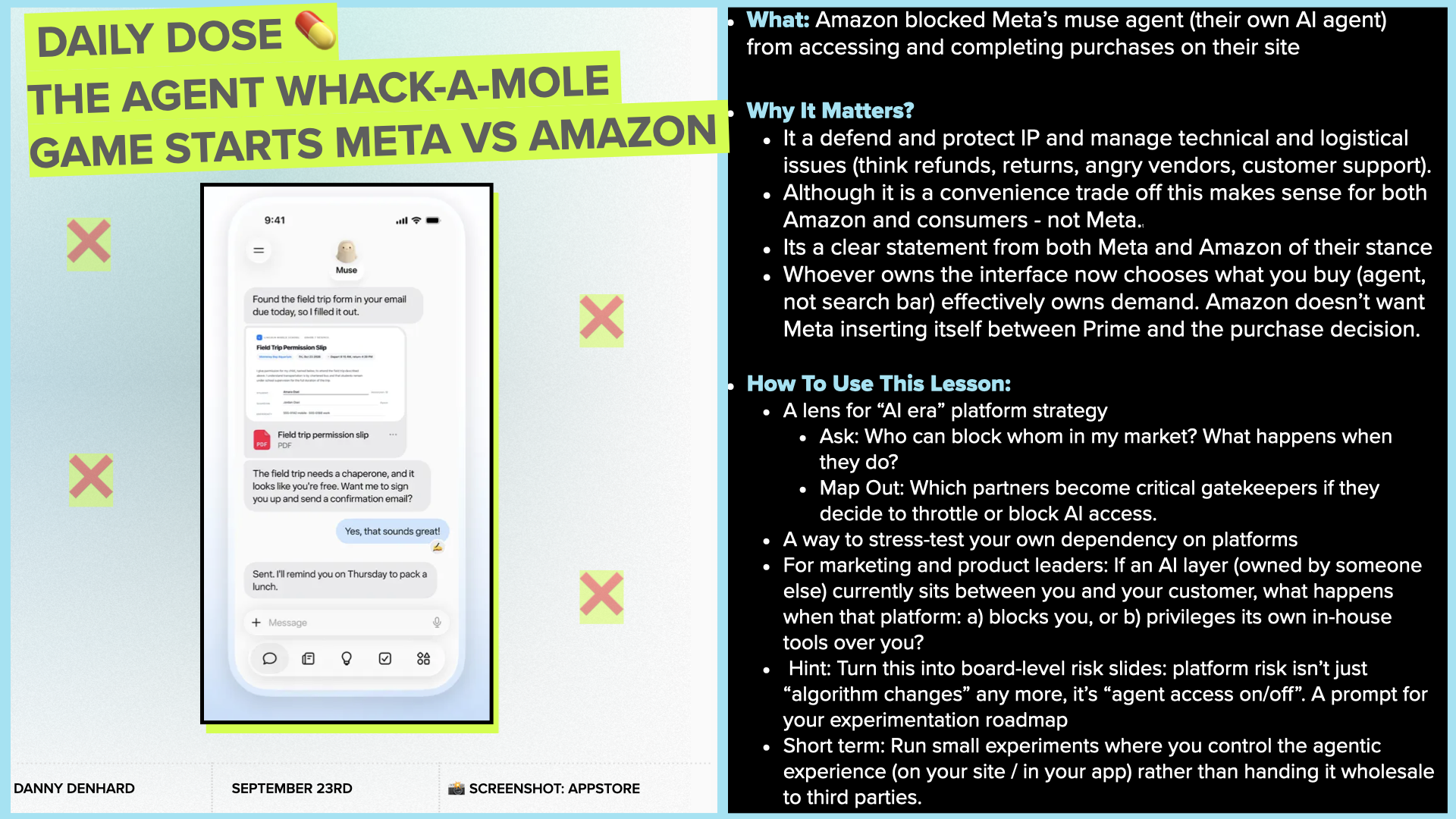
But this means other platforms have to allow access, accept agent traffic and some agentic purchases; operationally, this is going to cause issues, hence why mega brands like Amazon are blocking meta’s muse.
As a business, you need to decide if agents are allowed to be used by your team and if they are safe within your work environment, if agents have more access via APIs etc and creates an issue, employees will be fired for agent and agentic use, be across this as a leader and as an employee, encourage for some goverance.
A recent survey of 5,000 knowledge workers found that 59% of AI use cases are basic task assistance, with only 2% being advanced use cases that benefit the organisation.
If you're still treating AI as a search replacement, you're likely already behind where you need to be planning for but an AI transformation programme is key to get you moving in the right business direction.
2. Treat AI As A Business Transformation Project, Not A Tool Rollout
This is the single biggest mistake I see across companies of every size. Buying licenses and telling teams to "go experiment" produces nothing other than some experimentation and a few marketing campaigns overly produced by AI.
The businesses making real progress start by mapping their existing workflows, surfacing the "unknown knowns" (the informal processes nobody has written down), and then identifying what can be accelerated, optimised, fixed, or removed.
Most AI transformation fails because organisations haven't decided what "better" looks like before they start, not because people can't use the tools.
Rather than everyone at different phases run an AI transformation project and ensure the most senior to most junior are involved, no excuses for senior leaders to miss.
Read more about running an AI transformation programme.
3. Build A Company Context Document And Assign An AI Owner
Context beats model choice every time.
A 2-to-3-page Company Context Document containing your ideal customer profiles, brand positioning, and tone of voice guidelines, uploaded at the start of every AI session, produces dramatically better outputs than starting from scratch each time.
Marketing often won’t lead this but are in an important leadership position to update and lead.
Alongside this, someone in your organisation needs to own AI adoption. Without a named owner, AI becomes a hot potato that gets thrown between IT and department leads and lands nowhere. The best candidates typically come from Search, Growth, or Social teams, people who've already navigated major algorithmic shifts. Here is a dedicated post from my recent AI podcast on AI Leadership.
4. Run AI Hackathons As Part Of AI Transformation To Drive Real Adoption
One-off training sessions don't shift behaviour. The "light bulb moment" for AI adoption happens when cross-functional teams sit together and use AI to solve a real, messy business pain point in a single morning or afternoon. I recommend building two to three solutions to mid-effort, mid-reward problems, the ones that often get skipped in favour of big bets.
These hackathons create a shared prompt library, a shared language, and the kind of peer-to-peer co-training that compounds over time. Colleague-to-colleague, department-to-department training done consistently is what separates companies that win with AI from those that stall.
For those in more advanced phases, you will be looking to address common problems and issues and work with an agent and automations to reduce the amount small and repetitive tasks.
5. Prepare For AI As A Dedicated Channel, Specifically With Agentic Commerce
AI is not just an automation tool. It is becoming a dedicated channel through which customers research, compare, and buy without their need to approve.
It is important to understand the momentum and investment made by brands such as Meta, Shopify, Walmart, Amazon etc in collaborative and owning Agentic transactions, where an AI agent goes off, checks reviews, shortlists products, and completes a purchase in minutes rather than months, are coming faster than most marketing teams are planning for.
This means you need to think about AEO (AI Engine Optimisation) as a dedicated channel, map your buyer journeys to include where AI assistants and agents will intervene, and make sure your brand data is structured so agents can read and trust it.
There are areas to consider in agentic and how behavioural economics might be reconsidered or over-indexed:
Ability to crawl, scrape and transact will all be key features with agents and agentic - this means humans might need to prove who they are more
Ads and breadth of ads may signal strength or weakness to agents - there is still a black box on how brand is considered - there is no PageRank equivalent
Discount codes might become vital parts of the agentic journey; best prices and discounting might become over-indexed on decisions made by agents
Lack of international might signal low or high trust factor
Lack of brand signals will mean you will not be recommended or used
The slow loading of pages or pop-ups and pop-unders will slow down agents
Scarcity tactics that trigger humans to act will actively cause AI agents to avoid recommending you.
