Why Amazon Are Winning The Alternative Battle Against The Major AI Players
On our AI podcast, we often talk about the major LLM players, but we don’t cover how the big corps are fighting back against AI.
Today’s episode is one I have had slated for a while, and we jump into why Amazon’s prime expectations have once again helped their customers, adding Rufus AI to help convert users while blocking the LLM providers.
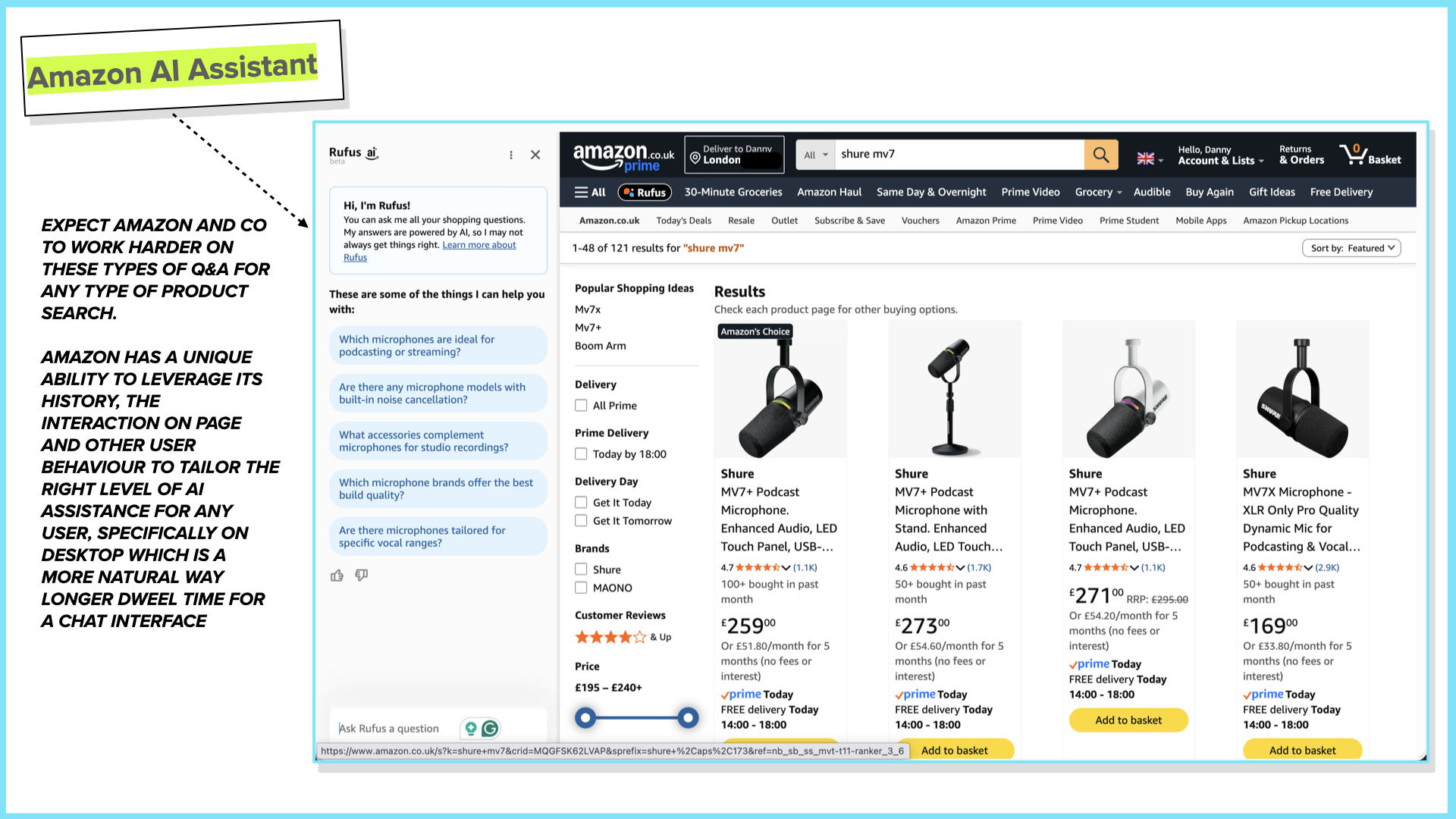
Here is how Rufus shows up on Amazon product pages
Listen To The 8 Minute Podcast
Here are my notes for recording the pod:
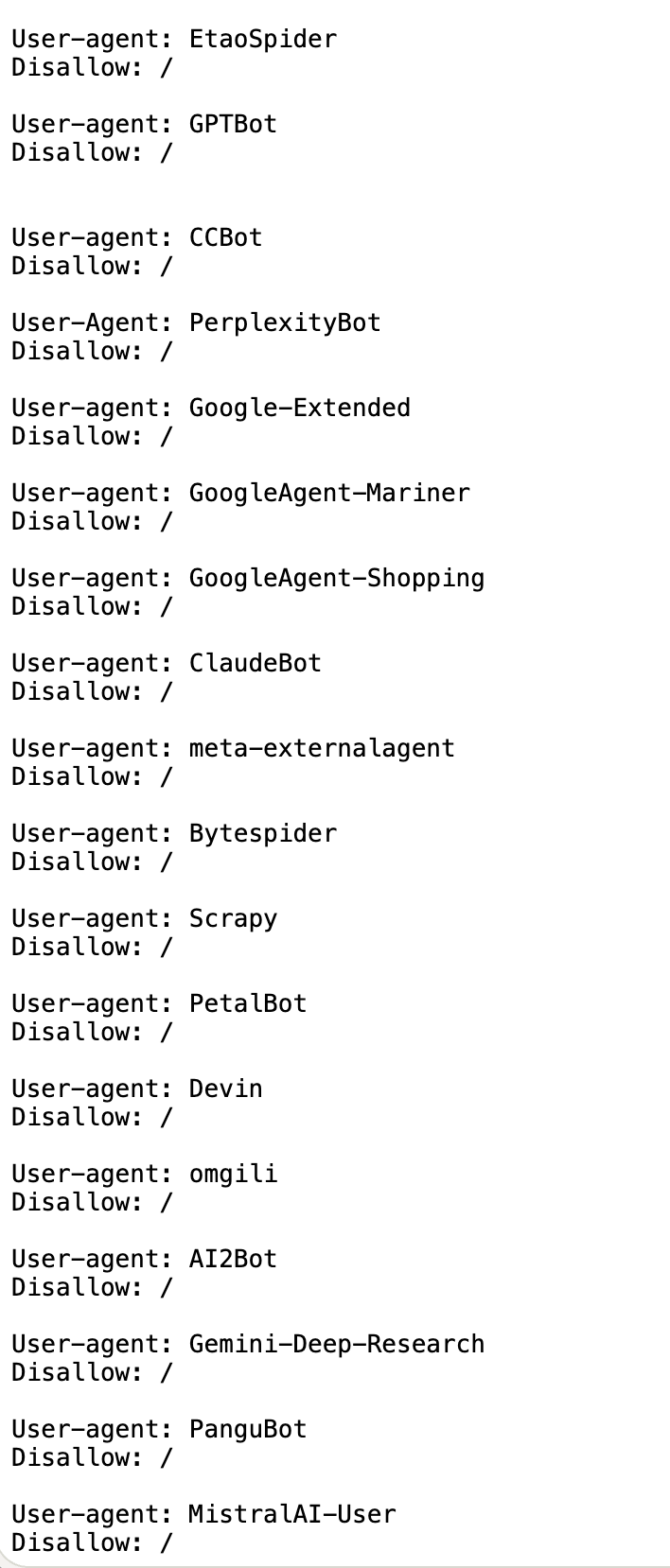
Amazon blocking LLM bots from crawling their site in their robots.txe file
Amazon’s landing pages are exactly what LLMs are looking for to offer the best pages and products
Amazon sets prime expectations, from creating super useful landing pages comparing products, long description, UGC and building in Rufus to help with purchases
Amazon have blocked all AI bots in robots.txt (shown above) - one of the only companies to really do this
Amazon Rufus is working well - AI-assisted sessions converting at 3.5 times the rate of traditional sessions. Amazon want to control customers’ experiences and rightly so
AI firms need corpuses like Amazon to learn what is good and how to compare products at scale - no better learning corpus
Amazon’s long-term play is to be direct in app or on-site buying (many of the large sites are slowly shifting users back to app first or web to app push)
Alexa+ should be a natural extension of Amazon AI - but will it be, and will users buy with voice
If you prefer reading, here is the full transcript:
The Amazon winning AI full transcript:
Amazon Vs AI & LLM Companies - Who's Winning & Why It Matters
[00:00:00] Amazon Vs AI & LLM Companies - Who's Winning & Why It Matters
[00:00:00] Jonathan: You're listening to the AI Moment with me, Jonathan Wagstaffe.
[00:00:03] Danny Denhard: And me, Danny Denhard.
[00:00:06] Jonathan: And Dan, what are we talking about today?
[00:00:09] Danny Denhard: Today we're gonna dive into, how Amazon have tackled their AI battle and how Amazon landing pages are the perfect example of what AI really wants. And that's a problem not only for AI, but also for Amazon and seemingly how Amazon might win or lose this battle. So my little fun fact for listeners who are unaware, Amazon have completely blocked in their robot.txt file, they've completely blocked LLMs.
[00:00:40] Danny Denhard: So whether it's OpenAI, Claude, et cetera, Gemini, they're not allowed to technically crawl their website. It's technically blocked. Whether they follow it or not, Amazon have stopped them from doing it. Yet Amazon information does appear quite widely [00:01:00] available within LLM. So what's your, what's your sort of take on this, Jonathan?
[00:01:04] Jonathan: Yeah, I think it's, um, uh, uh, you know about-- more about this than me, let me say first of all. So I'm, I'm learning from you on this one as much as anything. But, but it-- the, the way that Amazon product pages are structured, uh, is almost... You know, we go back to the, the, uh, interview we did with Geoff about two or three months ago about the way AI shops,
[00:01:24] Danny Denhard: No,
[00:01:24] Jonathan: structured nature of the data on an Amazon product page is just almost could have been written for AI shopping agents, even though it was designed years ago and it's been built over time. Because you've got, you know, they're structured, they're commercial, they're specific, they list the product attributes, they list comparisons with other products that are similar. There are buyer reviews on there, there are questions on there.
[00:01:46] Jonathan: There's all this stuff that the LLMs are looking for when they're trying to make their own mind up and recommend products to us.
[00:01:52] Jonathan: So, so you end up with this, you know, AI-- the AI LLMs want Amazon's data, they can't have it. But actually, in [00:02:00] the way that they're operating at the moment, as you say, they seem to be getting some of it somewhere, and that may end up strengthening Amazon's position. You may end up with Amazon's shopping being the recommended
[00:02:10] Danny Denhard: by
[00:02:11] Jonathan: default because it's so big and so feature-rich. so it-- you may end up with this weird situation where even though Amazon is, is blocking it... And they may have thought this through already, Dan, of course, that they're blocking the LLMs, but actually they, they win anyway. That-- It, it just-- That's how it seems to me. Look, you know a lot more about this than me, so, so tell me where I've gone wrong then.
[00:02:29] Danny Denhard: it's all, all right so far. Their-- The way that Amazon is structured and the way that they structure their data, uh, and their copy is the perfect example.
[00:02:41] Danny Denhard: They did it because so many other people couldn't do it, and they have all this corpus and this long, long history of, of data so they can basically create the best pages and the best product pages that are ever available.
[00:02:54] Danny Denhard: And almost every one of their competitors have struggled with is creating the same set of information and [00:03:00] data and landing pages that, that do it.
[00:03:02] Danny Denhard: I call it prime expectations. So what Amazon is uniquely good at is setting up prime expectations. So whether that is delivery within four hours, 24 hours or, or when you want it, they're uniquely good at it.
[00:03:15] Danny Denhard: They're uniquely good at getting it to you, and other, other competitors have really struggled there. They've also been really smart in setting prime expectations from their landing pages and then who works with them, they have to fall into their, their way of working. So if you sell on Amazon, they take 60%.
[00:03:35] Danny Denhard: So it's, it is this really interesting way of, of, of dealing with it and setting those expectations and long descriptions, and comparison tables, et cetera, has enabled them to prime us as the users to buy from them.
[00:03:50] Jonathan: Yeah. Well, they're, they're giving us all the things that we've, we've shown them over time we want, right? They're-- I mean, their, for me, their, their mission over the last 20 years or more has been to take [00:04:00] friction out of shopping. And you look at every initiative they've got, i-online, you know, with the stores that they've acquired and started to open, just everything is take all the friction you can out of the buying process. And so th-that... I, I think the way their pages have emerged over time is b-because we wanna see reviews, we wanna see product comparisons, we wanna see related products, we wanna see product data.
[00:04:22] Jonathan: And life has taught them over the last 20 years that they-- to-- they've honed, and honed, and honed, and redesigned those pages till they give us exactly what we want to buy the product quickly. And of course, those things are the same things that the AI tools, the LLMs are looking for to make their decisions about recommending as well. They may end up with a very, very strong position.
[00:04:39] Jonathan: The other thing I've heard of, and you, uh, you tell me if you know about this. A thing called Rufus.
[00:04:42] Jonathan: They're doing a thing called Rufus, which is their own AI shopping agent piece as far as I can understand. But again, you may know more than me on that one.
[00:04:50] Danny Denhard: Yes, it sits on the left-hand side on desktop, and it's also the bottom right on the app. Uh, it's their AI, and it converts sessions at [00:05:00] 3.5 times the rate of traditional sessions. So yeah, it's, it's just this optimized way of, of converting users.
[00:05:09] Danny Denhard: Some of their competitors will-- might have equally as impressive, uh, conversion rates, but it just shows you how AI can improve some of the user journeys.
[00:05:20] Danny Denhard: It can improve actually people discovering the products. 'Cause one thing Amazon aren't particularly good at is in their search results. They're great at, um, monetizing ads. They're not so great servicing their best products because it doesn't serve them as well. So it's something that I think they've learned, and they've probably taught the industry really well, like Google has, around ads and, and servicing that.
[00:05:42] Danny Denhard: But as we've said previously, they've got Alexa Plus, which is coming back out, and that's a natural extension of Amazon AI. I would say this is the... this will be the killer use case if they can nail voice and repeat purchases through voice and Alexa Plus products. I [00:06:00] think that's where they're gonna win big.
[00:06:02] Danny Denhard: But it just shows you how some AI companies or some companies have gone all in on AI and LLM tech, and others have decided, "Well, no, our brand, our experience, our touch points are far more important." And I think brands like Amazon, there's probably gonna be ones like Disney, these generational brands that are gonna just kick the door in and say to AI companies, "Nope, you're not-- you can't come near us, and we're not gonna let you do what you want to do.
[00:06:30] Danny Denhard: We're gonna own this, and we wanna own our customer journey."
[00:06:32] Jonathan: You're back to owning the data and owning the customer and all that kind of stuff, as you say. I know the, um, a number of them are working on that. I know there's also a number of third party AI enablers for things like Shopify, and there's some decent numbers being talked about. They're sort of saying, you know, 20...
[00:06:49] Jonathan: I've heard 15, 20 and 28% uplift in average order value by using AI, you know, agents or add-ons to Shopify from various companies. So it's probably... If [00:07:00] you're in the world of e-commerce, it's probably worth looking at. You know, outside of the Amazon thing, it's worth looking at whether AI could help you uplift your average order value.
[00:07:07] Danny Denhard: Yeah, Shopify said AI-driven orders are up 13X, AI traffic to Shopify stores are up 8X, and then Sidekick usage is 4X. So it just shows you if you can be really thoughtful and you've got a good brand, if you're thinking of it as an extension and another channel, it can do great.
[00:07:27] Danny Denhard: Otherwise, you can, you know, you can put guardrails up to, to try and prevent it and ensure that your, your brand, your experience is something that you, that you can control and you want people to come back to your home and hub, which will be either your website or app.
[00:07:43] Danny Denhard: It's just a strong signal for, for, for the rest of us to either decide to go in or to s- to stay out.
[00:07:51]
[00:07:51] Jonathan: Well, I think the... So the TLDR for me on this one is, the theory was that we're using LLMs to help recommend products to us and even obviously start to build in [00:08:00] buy agents into those LLMs. So you bypass everything. You're dealing directly with whoever is making the product. But actually, that would disintermediate Amazon.
[00:08:07] Jonathan: But actually, instead of disintermediating Amazon, AI might actually make Amazon's structured data they have more valuable. And so, you know, the winners might be in, uh, like Amazon, the firms that already have got rich structured environments that they control the data rather than flashy standalone models.
[00:08:25] Jonathan: So a- AI v Amazon may turn into AI helping Amazon win is my TLDR from this.
[00:08:31] Danny Denhard: And my little extension to that of, of all your, your points is often with experiences like Amazon and, and businesses like Amazon, what they're gonna be doing is they're gonna be using all of that information and all of that external noise and turn it into signal for them then to be so great that you're gonna actually want to use LLMs to go through and purchase through them and they're actually on Amazon.
[00:08:56] Danny Denhard: Or you decide, "Nope, we know they're not coming up, we're gonna go [00:09:00] direct." So completely agree, and Andy Jassy and co have been super smart about it.
[00:09:05] Jonathan: Indeed. Good see you, my friend, and I will see you next time.
[00:09:11] Danny Denhard: Thanks for listening, everyone.
[00:09:12] Danny Denhard: Thanks for listening today everyone. If you liked what you heard, please give us a rating and review in any of the podcast players. We have a supporting newsletter, which is ai moment.co uk that comes out on Mondays and Fridays with every pod, and we dive a little bit deeper, so please subscribe there.
[00:09:30] Danny Denhard: Have a great week, and we'll see you soon.
