From Reddit Chaos to ChatGPT Clarity: A CMO’s Guide to Smarter Bets

This is from my upcoming Marketing Unfiltered article 89, diving into the two questions I have been asked most frequently recently.
Is Reddit Worth the Risk for Marketers/Brands?
Reddit is both one of the hardest platforms to control for brand safety and one of the most genuinely “human” places online.
For CMOs, the question is not whether it is risky, but whether the upside justifies managing that risk. I have worked with a small number of brands who have had a strong Reddit presence and it was not pain free and often caused real and regular concern across the team and SLT.
The Case Against Reddit
Reddit’s community moderated structure creates real exposure. Conversations are messy, blunt and often suspicious of overt marketing. A clumsy activation can turn into a visible thread of criticism that is hard to contain.
Brands also have less control than on identity based platforms. You are entering communities that feel they own the space and will quickly call out self serving behaviour.
Historic links with controversial subreddits still influence perception in cautious or regulated organisations, slowing internal approval and reducing appetite for experimentation.
The Case For Reddit
At the same time, Reddit hosts exactly the kind of human, context rich content that is becoming scarcer elsewhere.
People use it for honest reviews, product comparisons and advice before purchase, which makes it powerful across the full funnel, from discovery through to decision.
Because users are not tied to real world identities, they are more candid about needs, anxieties and frustrations. This gives marketers unfiltered insight and a live test bed for messaging.
Campaigns that engage with criticism, such as Dove’s, show that open dialogue and radical transparency can increase trust rather than weaken it.
Reddit’s decentralised, moderator led structure is difficult to copy, which makes its communities defensible.
Its content is also highly visible in search and to emerging discovery tools, so earning authority in key subreddits can shape how your brand is found in future.
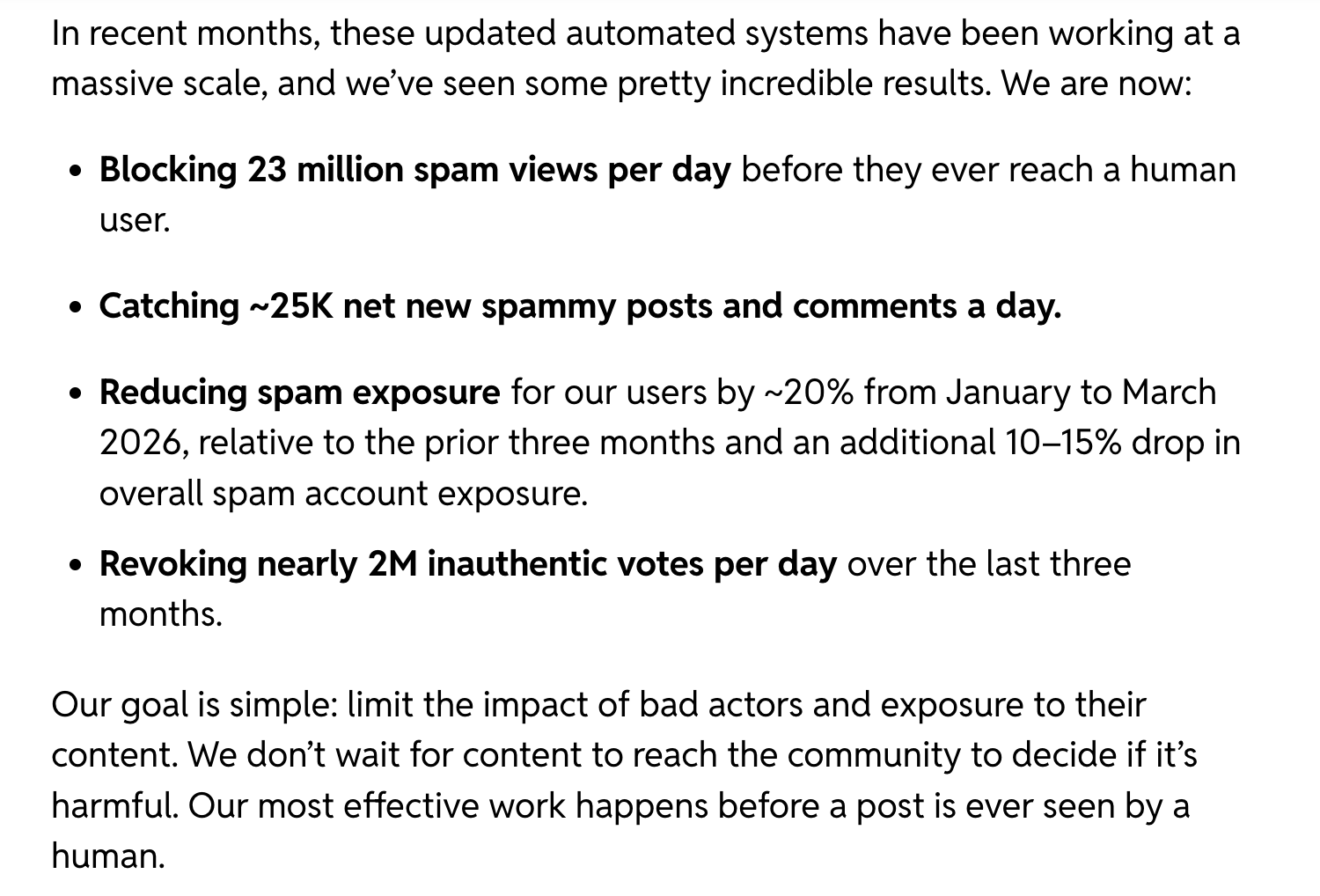
Reddit recently released how they are protecting human conversation and stopping AI and spammy behaviour before it happens:
What Marketing Leaders Should Do
Learn the platform, invest significant time and energy into learning the platform, the platform’s sub-culture and the nuance of Reddit vs other social networks.
Treat Reddit as a participation channel, not just an inventory source - be fully aware redditors will go for any opening to press and critique you and your brand (just ask Reddit CEO Steve Hoffman aka u/spez or listen to his appearance on Semafor Media podcast to hear the behind the scenes stresses, strains and successes)
Set clear guardrails and a subreddit whitelist to manage brand safety.
Invest in people who understand community culture and can respond with empathy.
Use listening to inform product, service and creative, not only media.
Plan for criticism and show how the brand will engage with it in public.
Reddit is not a set-&-forget performance platform. For marketers willing to trade some control for deeper human connection and sharper insight, it can be one of the most valuable and future proof environments in the media mix. But for others who are time poor and looking for spray and pray it won’t work for you and might do you more harm than good.
FWIW - I built a Reddit cheatsheet back in Feb, if you are at the start of your journey, i’d recommend reading, i’ve included standout examples of brands (like Adidas and 1password) using and leveraging Reddit.
How Should We Think About ChatGPT Ads?
ChatGPT now has close to 1B monthly users. Brands want to show up where real problems are being solved, not just where keywords live. That’s what makes ChatGPT ads interesting: they’re one of the first true problem‑state marketing channels.
When someone types “our sales reps keep losing deals at the proposal stage,” that’s not a keyword, it’s a confession. Being the ad that offers a “proposal coaching playbook” in that exact moment is showing up in the problem state, not just the category.
Why ChatGPT Ads Feel Different
Instead of bidding on brand terms and hoping to intercept demand, ChatGPT ads let you:
Appear as part of a conversational answer, not just as a banner or sidebar.
Align with a specific problem described in natural language. ChatGPT are selling themselves as natural language and being hired for problem solving, consider how you play here.
Offer a solution that feels more like help than a hard sell - be creative.
In reality, this is still paid media but it’s paid media that’s closer to the real questions your customers are asking and much closer to the mid to the bottom of the funnel. It is set up for problem asked → problem solved → conversion.
Remember chat is building it’s paid Chat → Citation → Sale engine - ads is an essential part to monetise it’s high percentage of free users.
The Measurement Tension: Content vs Ads
Most marketing teams are stuck between two imperfect bets:
Publish more content, on more platforms, and hope to be cited in answer engines and AI overviews.
Bid on inventory you can at least track (impressions, clicks, conversions) and justify to a CFO.
The traditional “bid → click → convert” model is what your C‑suite already understands.
The emerging “chat → citation → conversion” model is harder:
Prompts are opaque and iterative, not a single clean query.
Being cited is unpredictable and hard to reverse engineer.
Attribution from “answer mention” to “site visit” to “revenue” is messy.
This is why many leaders will default to ads first: they look safer and more measurable, even if they’re early and imperfect.
Key Watch‑Outs Before You Spend
Treat ChatGPT ads as test‑and‑learn, not a new budget sink.
Inventory is early: formats, policies, and performance will shift rapidly. Users are savvy and have worked out how to ensure ads often do not appear.
Some markets complain of high CPM, research this upfront and keep an eye especially in smaller markets.
Traffic is often coming in as “direct” as UTM have been known to be stripped out.
Be mindful there are often high bounce rates from Chat ads - the more refined the prompt the less likely there will be bounce.
You don’t see the full conversation: you’re entering a context you only partially understand (no prompts are included).
Brand safety and guardrails matter: tight creative, smart copy, clear exclusions.
Many report successes in ChatGPT ads are dependent on an associated offer, which suggests many are looking for discounts and savings inside their prompts.
Over‑reliance risk: this complements not replaces brand, product, and organic work. The more trusted and known your brand is, the more likely you’ll be cited and actively named in prompts over time, so you needing to pay should reduce down. Don’t get too high on the paid ChatGPT supply.
UK & EU regulators haven’t said much on the offerings, expect recommended changes in the UK and across Europe
When ChatGPT Ads Belong On Your Roadmap
Ads should be on your 6‑month plan if you are:
Launching in a crowded category where you need to show up in real problems, not just generic searches.
Competing with incumbents who dominate brand and category terms.
Under pressure to prove “AI‑era” experiments with clearer attribution and ROI.
Think of it as a balance:
Keep investing in durable, high‑quality content and brand building (long‑term visibility, citations, and trust).
Layer in targeted ChatGPT ad experiments mapped to specific problem states and journeys, especially from your internal data and third party sites collating information and insights for you to answer.
What To Do Next:
Map problem states: Gather the real phrases your customers use (use sales calls, support logs, community threads) – not just keywords, but complaints and confessions.
Turn these into offers: For each problem state, define a sharp, specific solution (hint:playbook, tool, framework, diagnostic, template).
Design tight guardrails: Clarify where your ads should and shouldn’t appear, and what language is non‑negotiable from a brand and compliance perspective.
Set CFO‑level metrics: Decide in advance how you’ll judge success – cost per qualified visit, pipeline influence, incremental revenue – and keep the experiments small and time‑bound.
Build the story for the C‑suite: Frame this not as “chasing another platform,” but as testing a more measurable way to show up at the exact moment a customer describes their problem.
It’s not “organic content or ChatGPT ads.” It is both – but the mix, and how you explain that mix to your C‑suite, is what will decide whether this feels like a smart experiment or another AI distraction.
By Danny Denhard - Let’s Connect On LinkedIn
- Speak to me about coaching, consulting and CMO advisory.
