Your Daily Dose Of Marketing Medicine
Each year I set myself a challenge; this year I undertook several private and public challenges, one of my public challenges is a public swipe file, which I call The Daily Dose.
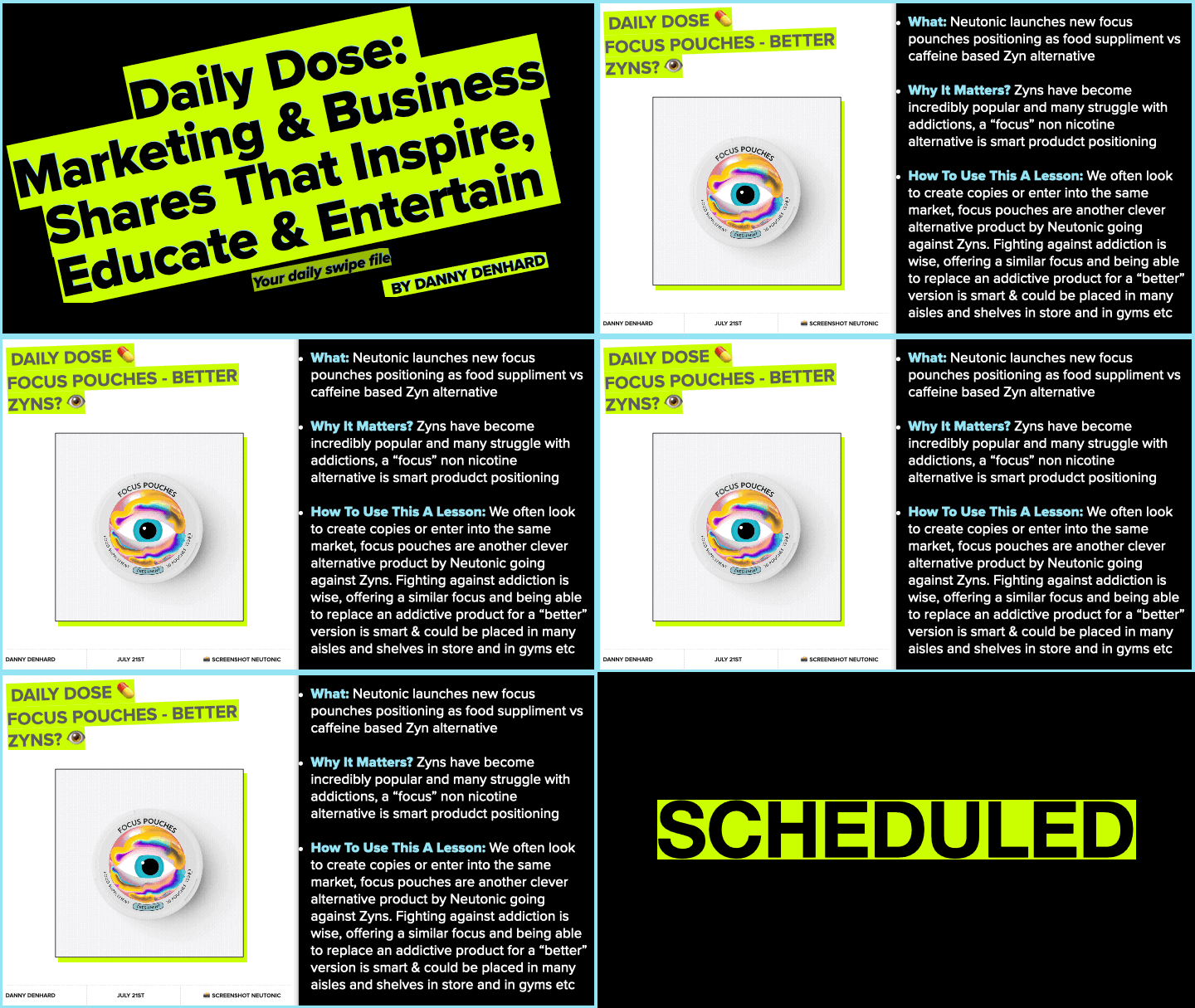
Flick through below
or here’s a PDF download
Daily Dose is a curated daily (yes daily) swipe file (great ideas to keep a copy of and be inspired by in the future). It’s designed to inspire, educate, and entertain, but more importantly, to be genuinely useful for busy marketing, product, and business leaders.
One thing I miss from not having a team or consulting with a Marketing team is sharing and discussing campaigns, products and smart uses of tech and apps.
The best teams I have been part of (one of my leadership teams I was part of had this exercise as a core part of the ELT meeting) and run, have open and creative sessions sparked from curiosity and an ability to be inspired or reject other people’s work.
Rather than dumping links or headlines, every day edits follow a simple, practical framework:
What it is
Why it matters and
How to use it.
For instance, this is tomorrow’s daily dose, breaking down why Kraft Heinz and Disney are such a smart partnership
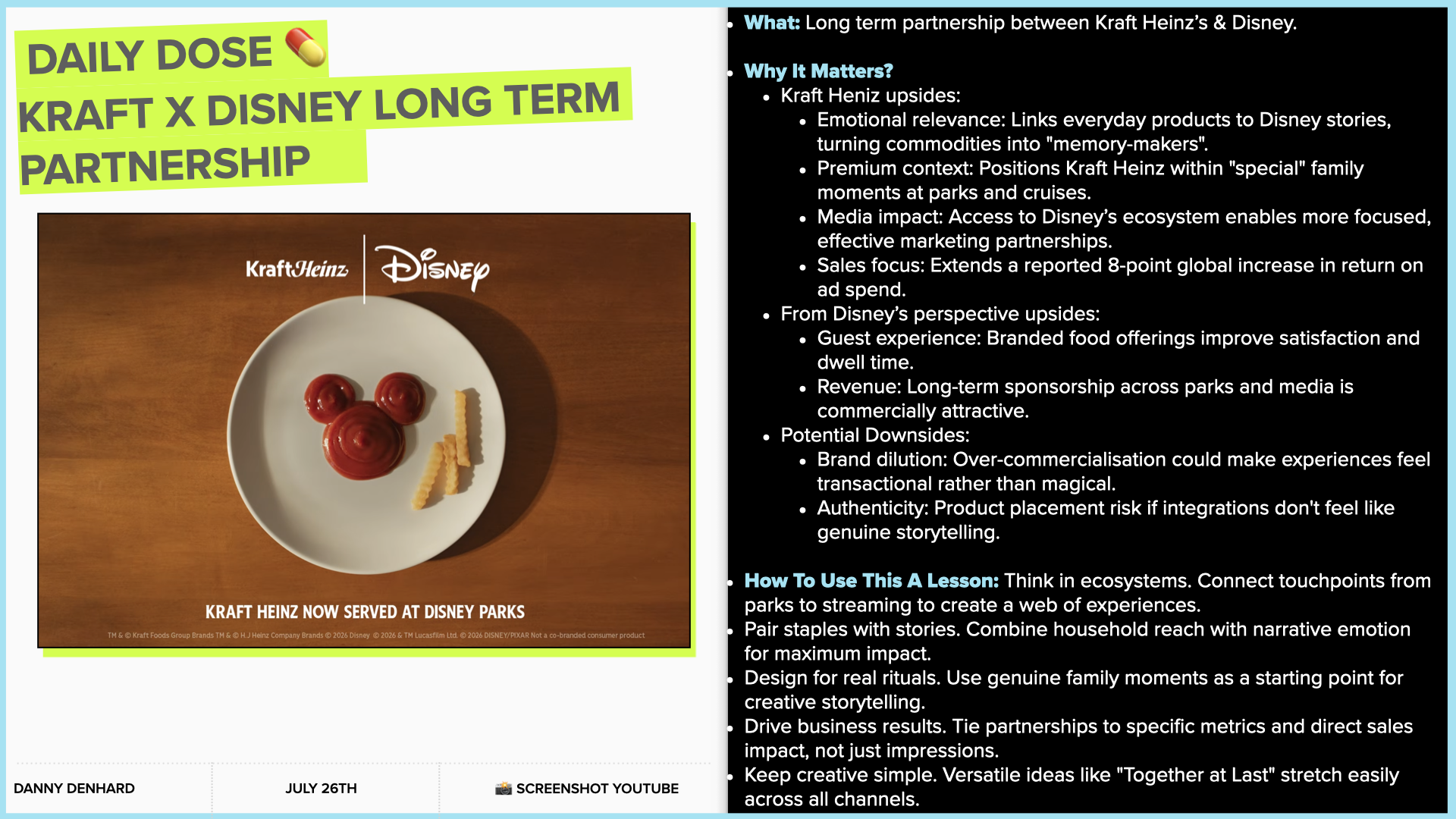
So instead of just watching trends go past or not keeping a record of something timeless (not just over indexing on timely, which a lot of marketing teams are now guilty of, we all chase that dopamine hit) you get a clear breakdown of how to apply them to your own brand, campaigns, and products.
What A Daily Swipe File Does For Teams
A swipe file is a bank of proven ideas, copy, and creative that you can draw from when you need to move quickly. I select slides as its the easiest and most open format to share and create comments for only the cost of my time.
I often recommend in my coaching to create a shared space (on Notion, Slides, your internal wiki, Teams/Slack, although chat apps are very hard to take out the knowledge (although agents are making this easier) and often chat channels are ignored) where you’d discuss each and the trick is to turn this into a daily discipline gives teams a real edge:
Keeps ideas flowing laterally: By comparing very different brands and sectors, for example, a Stella Artois bus stop ad versus Sephora’s in‑store experience, teams are nudged out of their usual thinking patterns.
You see how ideas travel across categories, not just within your niche.Stops every project starting from zero: Instead of staring at a blank page, teams can lean on tested frameworks, partnership models, and positioning approaches they’ve already seen work elsewhere.
Builds a habit of strategic analysis: Because each example is broken down into the why and the how, it doubles as on‑the‑job training. People don’t just save good work; they learn to reverse‑engineer it.
Keeps everyone aligned and ahead: The same set of cultural shifts, tech changes (like Agentic AI), and platform updates are landing in everyone’s inbox. Less time trawling for updates, more time acting on them.
There is a trade‑off: you’re curating and interpreting other people’s work rather than inventing everything from scratch. But for most teams, that’s a strength, not a weakness.
The process and collaboration are important and will help inspire your team and cross-functional teams. Want to copy this or roll this out?
My Process?
I will scroll through Instagram, X, LinkedIn, TikTok, Substack app, YouTube, go through my RSS (I’m proudly old school), read numerous newsletters (industry dive newsletters are great for this) and go through 5x automated alerts. I’m also part of a couple of great communities who share high-quality work and discuss further. I will also often receive WhatsApp messages from industry friends and ex-clients and ex-colleagues, which I can also include.
I screenshot, create a vanity URL on my tool created by Chris Hutchings (thanks for the gift), knock up the slide on Keynote and then share onto Google Slides, X and Substack.
Yes, I could automate a lot of this, but that doesn’t build any muscles and I’m enjoying the process. Maybe there will be a video series coming to a short-form platform near you.
💬 If you’d like to discuss any of the daily doses I have turned on comments on Google Slides or you can email me mu@dannydenhard.com
I’m now a month into the experiment, and here are some core themes (there are some personalised themes from my walks, social feeds and consumption diet; to keep it as neutral as possible I have 5x daily alerts to source great examples)
The Key Themes
The deck captures where marketing is heading in 2026/2027: more creator‑led, more conversational, more human, and more selective about quality (anyone can be about quantity). I also covered the 6 key themes for H2 on MU87.
1. Athlete‑Led and Creator‑Owned Brands
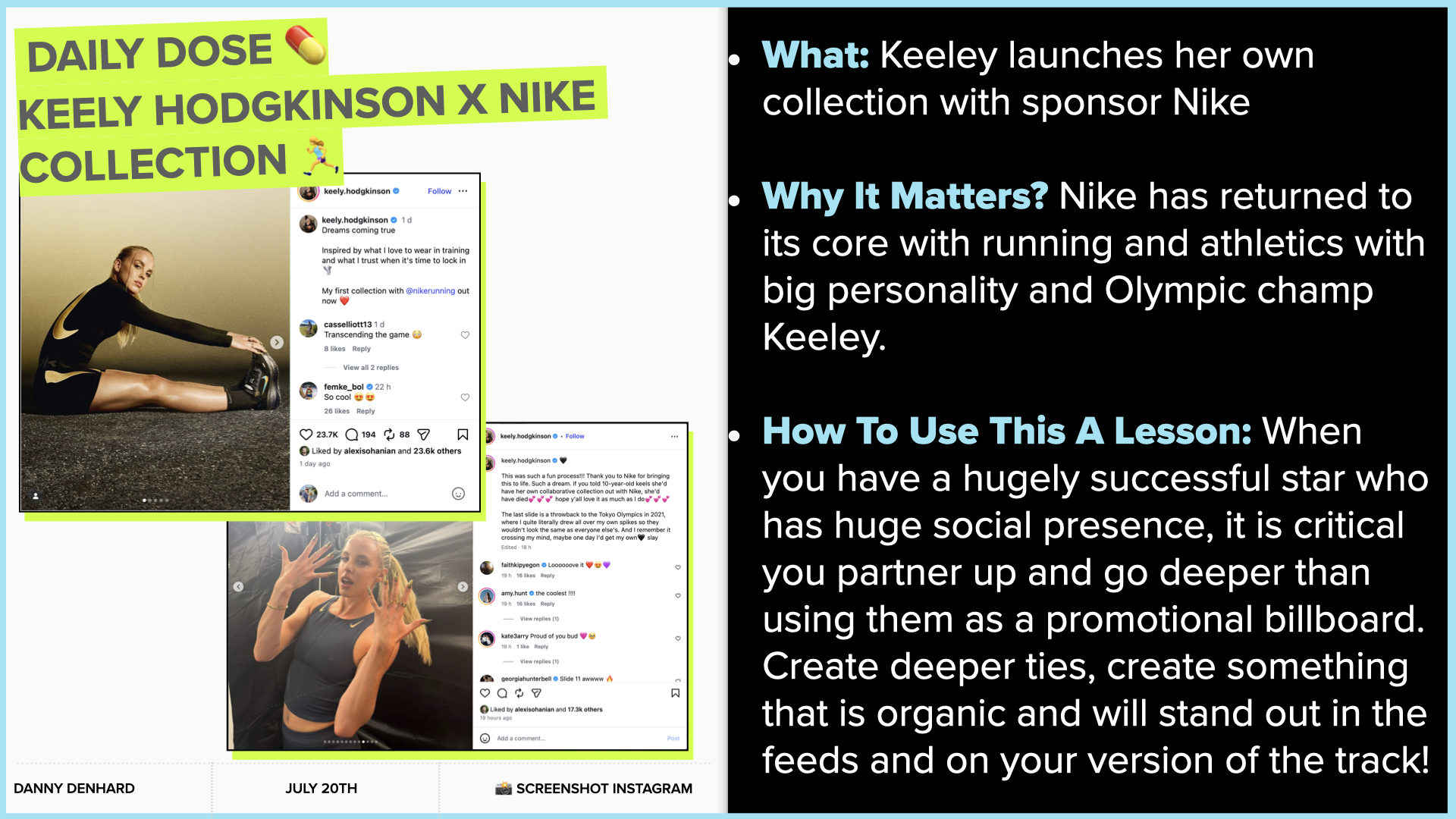
Endorsements are moving from influencer “hold the product and smile” to actual ownership and product creation:
Cole Palmer’s Cole’d Ice with GoPuff: Pebble ice with electrolytes led by a footballer, tightly linked to his personal brand and lifestyle. It shows how athletes can credibly stretch into functional products, not just merch.
Tom Holland’s Bero: A premium non‑alcoholic beer and shandy line aimed at luxury travel and recovery. This leans into the sober‑curious and performance‑driven consumer, rather than the old “celebrity slaps logo on lager” approach.
Keely Hodgkinson x Nike: An organic apparel collection tied to her values and performance story, instead of yet another series of generic sponsored posts. Keely stands out as she is a social native who gets the platforms
Invisible Sunscreen by Karolina Muchova & Priscilla Honn: A skincare line announced in the middle of Wimbledon, meeting a real, visible problem in full public view.
The upside: deeper authenticity, better margins, and long‑term brand equity.
The risk: not every athlete or creator has a good idea and will struggle to prove a coherent product vision. Audiences are increasingly quick to spot a cash grab…
2. Conversational and Agentic AI in Marketing
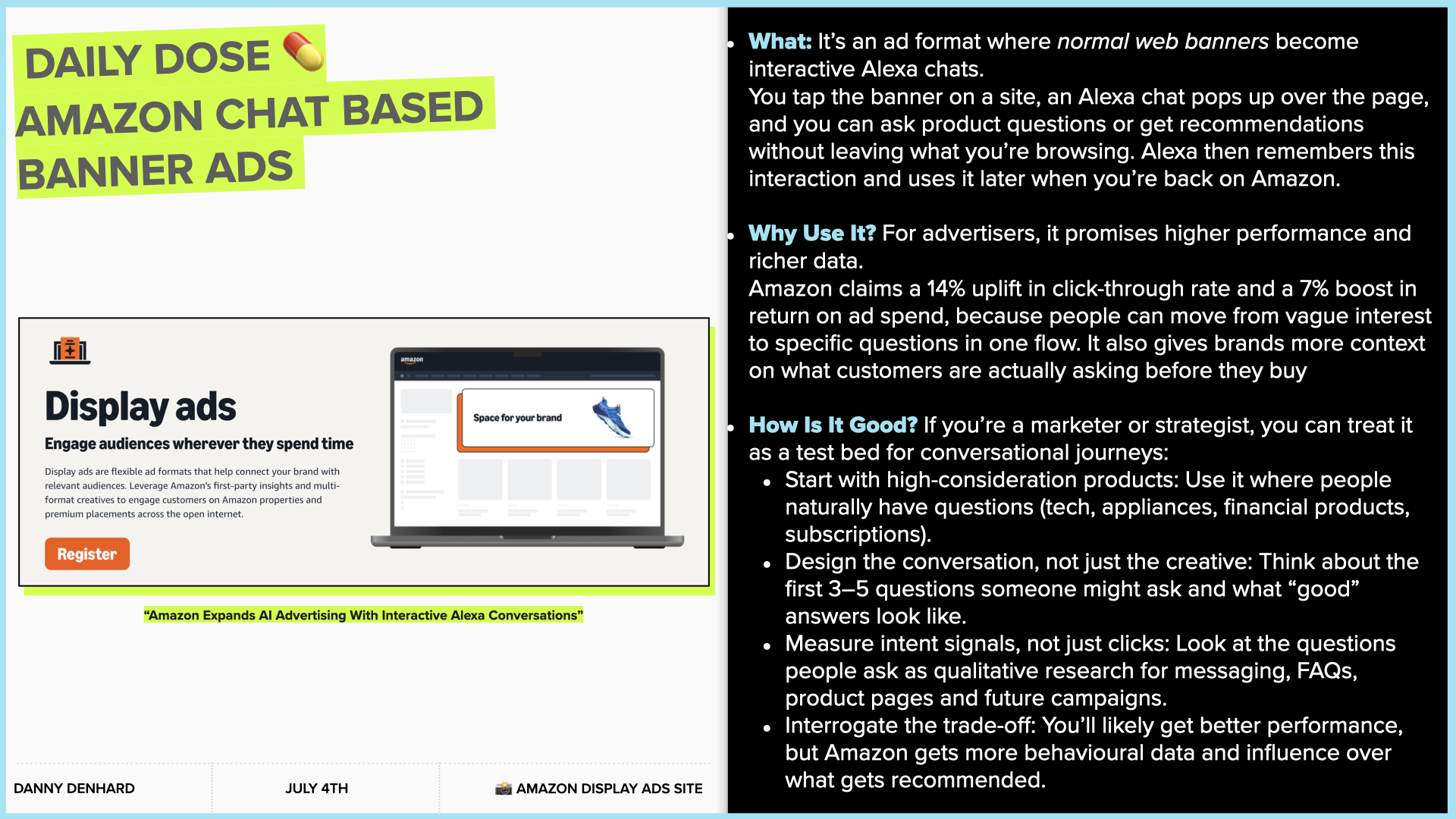
AI is moving from background automation to front‑of‑house experience:
Amazon chat‑based banner ads: Static banners are being replaced with interactive Alexa chats. Customers can ask questions there and then, leading to a reported 14% uplift in click‑through rate and 7% uplift in ROAS. It turns ads from a broadcast into a mini helpdesk - I suspect once these are more known they’ll influence more transactions
AEO (AI Engine Optimisation) & Agentic Commerce: The funnel is towards shifting to Chat → Citation → Sale. Some people ask an AI, skim its justification, and then buy. That means brands need to be optimised for AI systems (and moving towards agentic comms) as much as for human search.
Publishers reducing Google dependency: Media companies are actively diversifying away from search, spending more time building direct audiences, events, and licensing content into AI ecosystems. Some are even talking about blocking Google and we are seeing other industries considering this)
The opportunity is new, high‑intent touchpoints.
The flip side is loss of control: you’re increasingly at the mercy of opaque AI ranking and routing.
3. Human‑Centric and Inclusive Design
The work that wins increasingly respects people’s time, attention, and sensory load:
Sephora’s Quiet Hours: Global in‑store “quiet hours” with dimmer screens, softer audio, and fewer sensory triggers. Framed for neurodivergent and sensory‑sensitive shoppers, but in reality, a calmer experience benefits almost everyone. Expect more to follow suit.
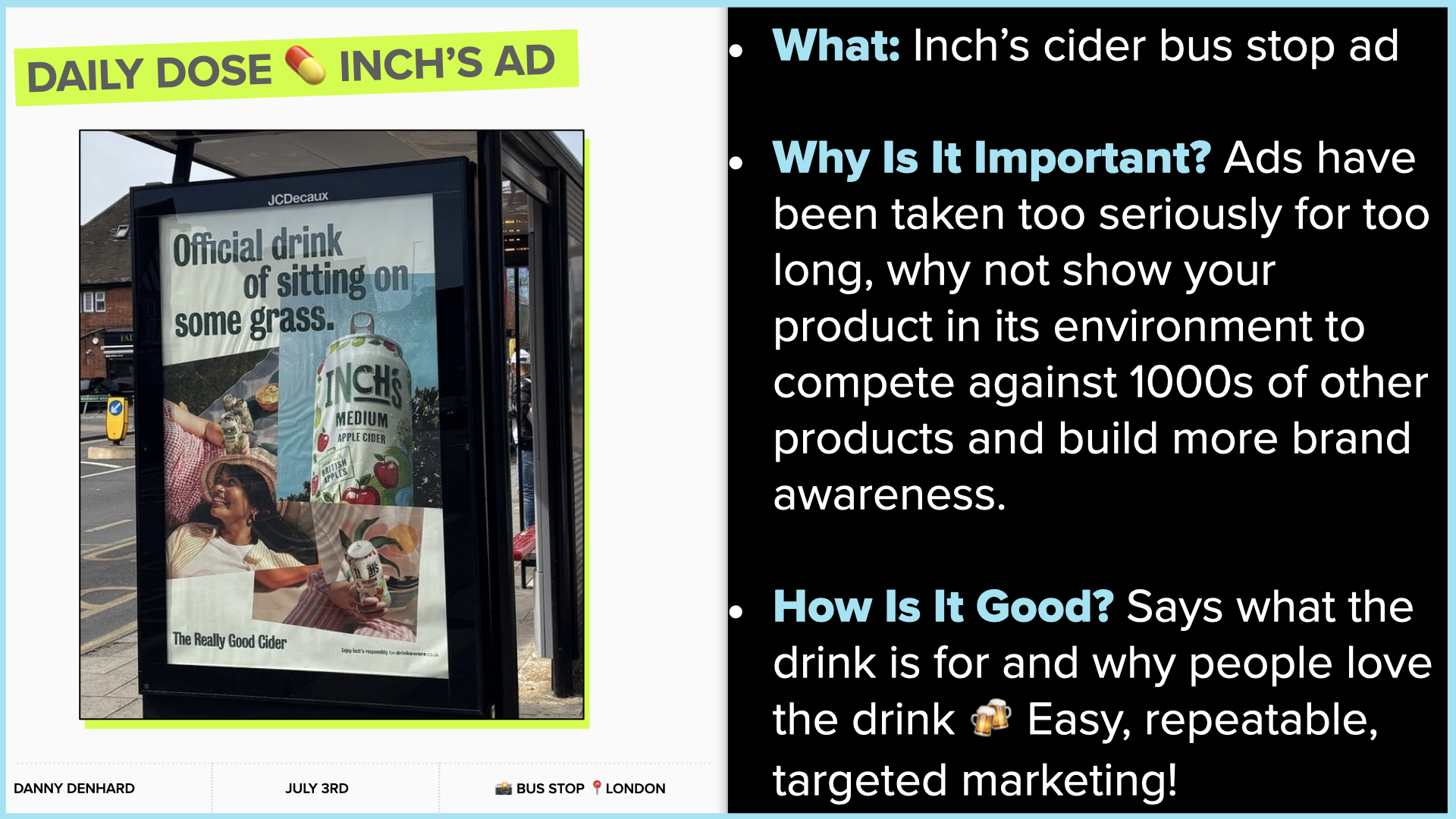
Smart, simple OOH: Campaigns like Stella Artois’ “The Perfect Serve” at Wimbledon bus stops, or Inch’s Cider calling itself the “official drink of sitting on some grass”, show that a clear, context‑aware line can cut through more than a clever paragraph nobody reads.
The benefit is accessibility and memorability.
The challenge is resisting the urge to over‑explain or over‑optimise every pixel.
4. Ecosystems and Unusual Collaborations
Brands are increasingly leaning on partnerships to borrow emotion, story, and reach:
Kraft Heinz x Disney: Everyday cupboard items tied into Disney stories across parks, cruises, and media. It turns basic products into prompts for family memories. Smart and likely cost-effective over the length of the partnership
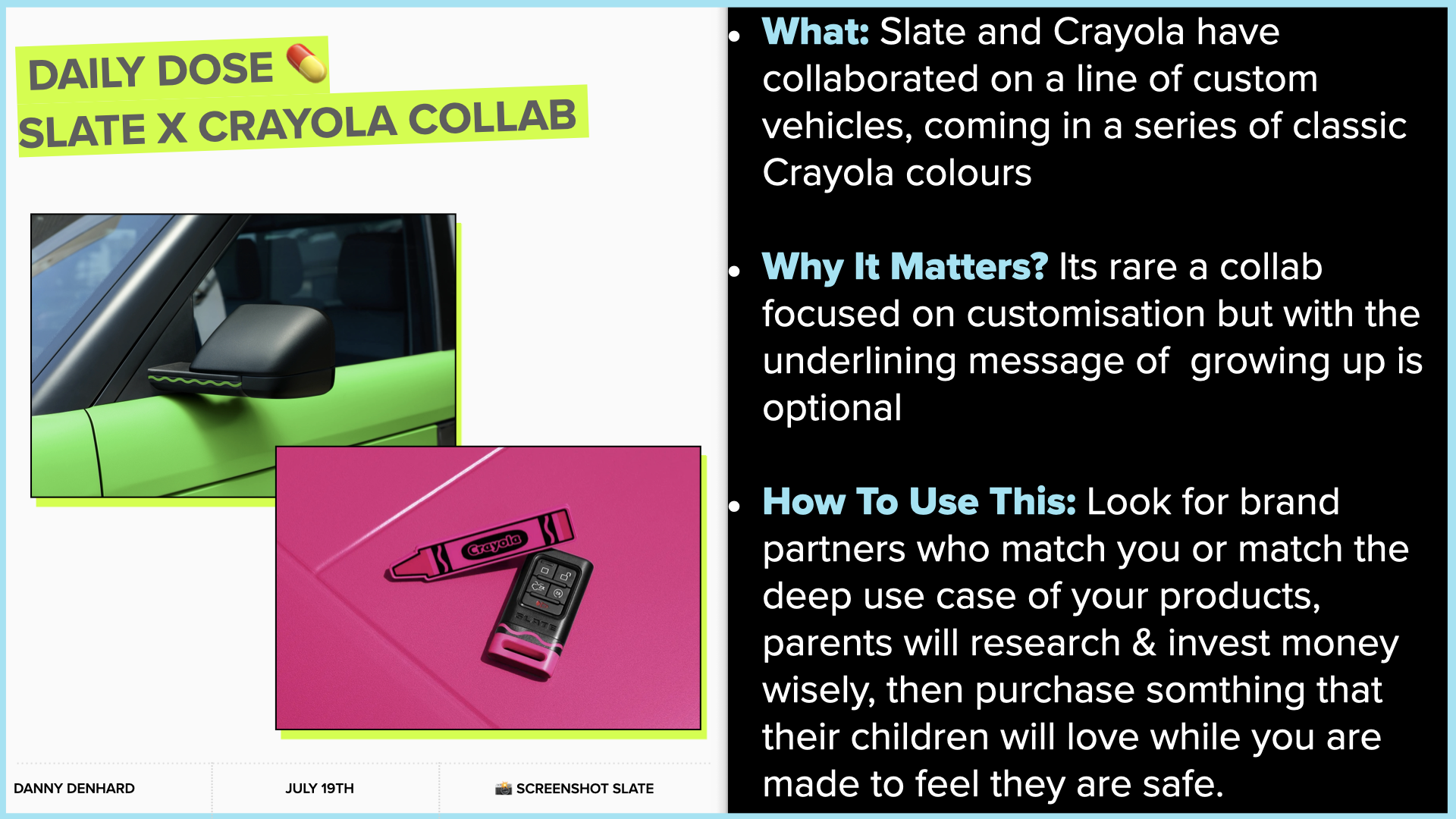
Slate x Crayola: Vehicles in classic Crayola colours with the line “growing up is optional” – blending utility with nostalgia and play.
Hot Ones x Netflix: A YouTube format that travels onto Netflix and, in turn, promotes Netflix’s own shows. It proves digital‑first IP can scale into more traditional premium environments.
The upside is fresh energy and shared audiences.
The risk is dilution if the partnership feels forced or values don’t line up.
5. Quality Over Quantity: The Counter‑Trend
As feeds fill up with low‑effort, cost of living increases and unstoppable AI‑generated content (aka AI SLOP), there’s a clear swing back towards fewer, better, deeper:
Sneaker brands slowing drops: Nike, Adidas, New Balance and others are easing off constant limited drops to tackle “Dunk fatigue”. Fewer releases, with more focus and better storytelling, are regaining some scarcity and desire.
Colossus and long‑form audio: While much of the industry chases short‑form, Colossus is betting on deep dives, detailed profiles, and high‑quality paid for narration by an award-winning narrator. It’s optimising for trust and retention, not just impressions.
If you find a daily dose/slide you like you can copy and paste that specific slide by copying and pasting the URL like https://docs.google.com/presentation/d/1h_YmXIzWXPgBmI9Dc-PvBbhANS-XwP72FAKbFXBP3wA/edit?slide=id.g3f3267fa73b_1_6#slide=id.g3f3267fa73b_1_6 for the most clicked daily dose so far, the Boz (Meta CTO) & Nicholas Thompson interview.
Have a great weekend and if you’d like to chat through the process or would like to introduce your own swipe file, drop me an email to mu@dannydenhard.com
This is my latest marketing unfiltered newsletter #91, going to be sent out on Friday 24th of July. Happily subscribe for a weekly email from marketing & business leaders.
