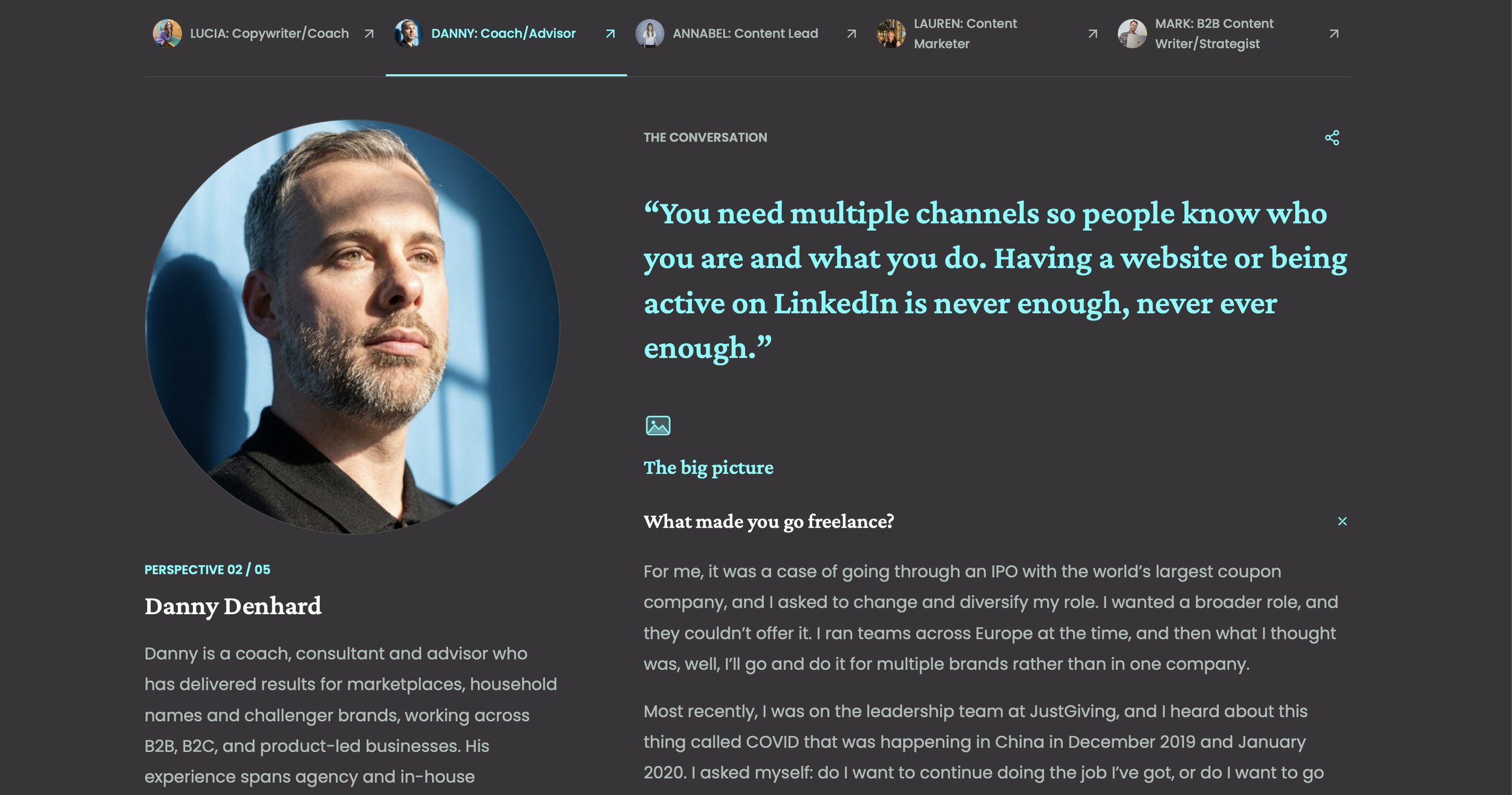
I was recently interviewed by Farah Cormack, the full interview project lives here, definitely take a read of the full run down, its a very strong and fair look at freelancing going into 2027. This is my section from the interview.
“You need multiple channels so people know who you are and what you do. Having a website or being active on LinkedIn is never enough, never ever enough.”
What made you go freelance?
For me, it was a case of going through an IPO with the world’s largest coupon company, and I asked to change and diversify my role. I wanted a broader role, and they couldn’t offer it. I ran teams across Europe at the time, and then what I thought was, well, I’ll go and do it for multiple brands rather than in one company.
Most recently, I was on the leadership team at JustGiving, and I heard about this thing called COVID that was happening in China in December 2019 and January 2020. I asked myself: do I want to continue doing the job I’ve got, or do I want to go back out, help other people again, and work for multiple brands again? It felt like the right time, so I negotiated and left at the end of March 2020.
What’s the best thing about being freelance?
For me especially, it’s to help as many brands and as many people as possible.
I knew if I went out [independently] in 2020, I was going to be able to coach a lot more, which gives me the most energy. I could then consult and build out that, do workshops, speak at conferences, etc.
And along the way, I decided that I was on a bit of a mission to fix the broken world of work. What that meant was I wanted to go out and help as many people as possible in as many ways as possible. So, it was really a case of going out, speaking to as many people as possible, finding out the problems I could help solve, and doing it.
When you go out and you become a freelancer, you can do as many different roles as you like. You can have full company influence, and you can really change how people view the business and what they decide to work on and roll those out. Whereas in other roles, you go in, you do your job, and in six weeks, 12 weeks, 18 weeks, or a year’s time, you’re leaving, and you know you’re leaving them in a better spot.
What’s the worst thing about being freelance?
Finding the work, and staying motivated when work dries up, which I think is the killer. Whenever I speak to different people, that’s what really hits them hard.
In this market, I think the true test of your character is when you’ve got people with limited business etiquette. So, they’re ghosting, they’re over-negotiating, they’re haggling the tiniest little things, and also haggling even when a contract’s signed, so they decide that they want to put something performative in there. That’s the hardest part, and no one really tells you before, and it’s getting worse now. So, if there’s ever the biggest tip I would give someone, it’s: grow thick skin and really understand how to handle yourself and learn when to say no.
Talking turkey
What’s the highest number of clients you’ve had at once? Was it manageable?
Six white-label consulting clients, three coaching clients and two advisory clients. The white-labelling was mostly for a company and an agency: auditing their customers or clients, building that out with them or for them, so they could pitch it as their own. Think of it as some work on the ground, some at 100 to 1,000 feet, and two at 10,000 feet.
Coming from an agency background, that was almost normal. If you came from an in-house perspective and had never done it before, it would be a really steep curve that people struggle with.
What’s worked for finding clients?
A lot of the time, it’s being in the right spots, being able to market yourself, knowing what you’re marketing, and knowing when you can really help someone.
For instance, I shared a Notion page in a group with the best articles, newsletters, podcasts and YouTube videos on marketplaces, something I’d collected over 12 years. Three months later, someone contacted me and said: “We’re going through a really tricky spot. Can you help us? We just don’t have time to consume all of that, and you’ve got all this knowledge.”
I also have three newsletters. There are different ways to bring people to me. Think of a hub-and-spoke model, with you in the middle, adding value to different people in different ways. So I’d always say, build the hub-and-spoke around you. Work out how you’ll add value to people in multiple ways, and how that will speed up your flywheel. You need multiple channels so people know who you are and what you do. Having a website or being active on LinkedIn is never enough, never ever enough.
Advice for anyone considering freelance life
What’s something that you’d say successful freelancers have in common? This could be personality traits, routines, beliefs, business structures, etc.
Thick skin, and the ability to take things on the chin, whether that’s feedback or someone being nasty or deliberately aggressive. That’s never something you should accept, but it’s part and parcel of the business world.
They know when to evolve their offering, and when to say yes and when to say no. That’s an important skill you learn over time.
They know when to ramp up and when to ramp down. And they know things are going to hit their confidence a lot of the time: when things are great, you’ll know they’re great, and when they’re not, your confidence will take a hit.
Is it easier or harder now to be a freelancer than it was when you started?
Right now, you should definitely have 6 to 12 months’ worth of money saved, 100%. I’ve never seen a market so challenging, other than for very specific specialisms and skills.
If someone came to you and said, “I think I want to be a full-time freelancer. Should I?” What's your answer?
Right now, I think it’s really difficult for people to want to go out and do it. You need to know what type of business you are. You always have to be marketing, you have to know what value you’re giving to someone, and you have to understand how thick your skin is, how many “no”s you’re going to receive, and when to evolve your offering versus sticking with it.
What's the very first thing you would advise a new freelancer to do when starting their business?
Absolutely first: go and market your services, whether it’s a one-pager, a video, or telling all your friends to tell a friend. If you don’t do it, no one else will, and no social network gives you free publicity anymore. You really do need to be the one singing your own praises.
That’s the most critical skill I think people have lost. They forget to market themselves, even in marketing: to go out and actually market you and your services, and why you’re different, standing out rather than blending in. That comes down to knowing your expertise and your specialisms, and knowing that sometimes people will hire you for one really specific part of that.
