This is a slightly tweaked version of Marketing Unfiltered 101, my weekly marketing leadership newsletter.
You have made it to Q4.
This is the perfect moment to step back, reset how your team thinks about brand, and give performance‑first stakeholders a new way to see long‑term brand value.
This newsletter gives you two practical tools:
A simple brand game to expose how brands really live in people’s heads.
A reverse engineering exercise to unpack what actually drives brand results.
Use both to turn vague “brand spend” debates into concrete, shared understanding.
The Simple Brand Game
Most companies have the same problem: leadership does not really believe in brand investment.
You hear versions of it everywhere:
“My c‑suite does not get the power of brand.”
“I cannot land brand investment with the CEO or the board.”
“I am always fighting finance and revenue leaders about brand spend and ROI.”
“They only care about performance ads, I argue for brand spend every week.”
The game is built to surface those biases in a way that feels light but lands hard.
Run the Brand Game
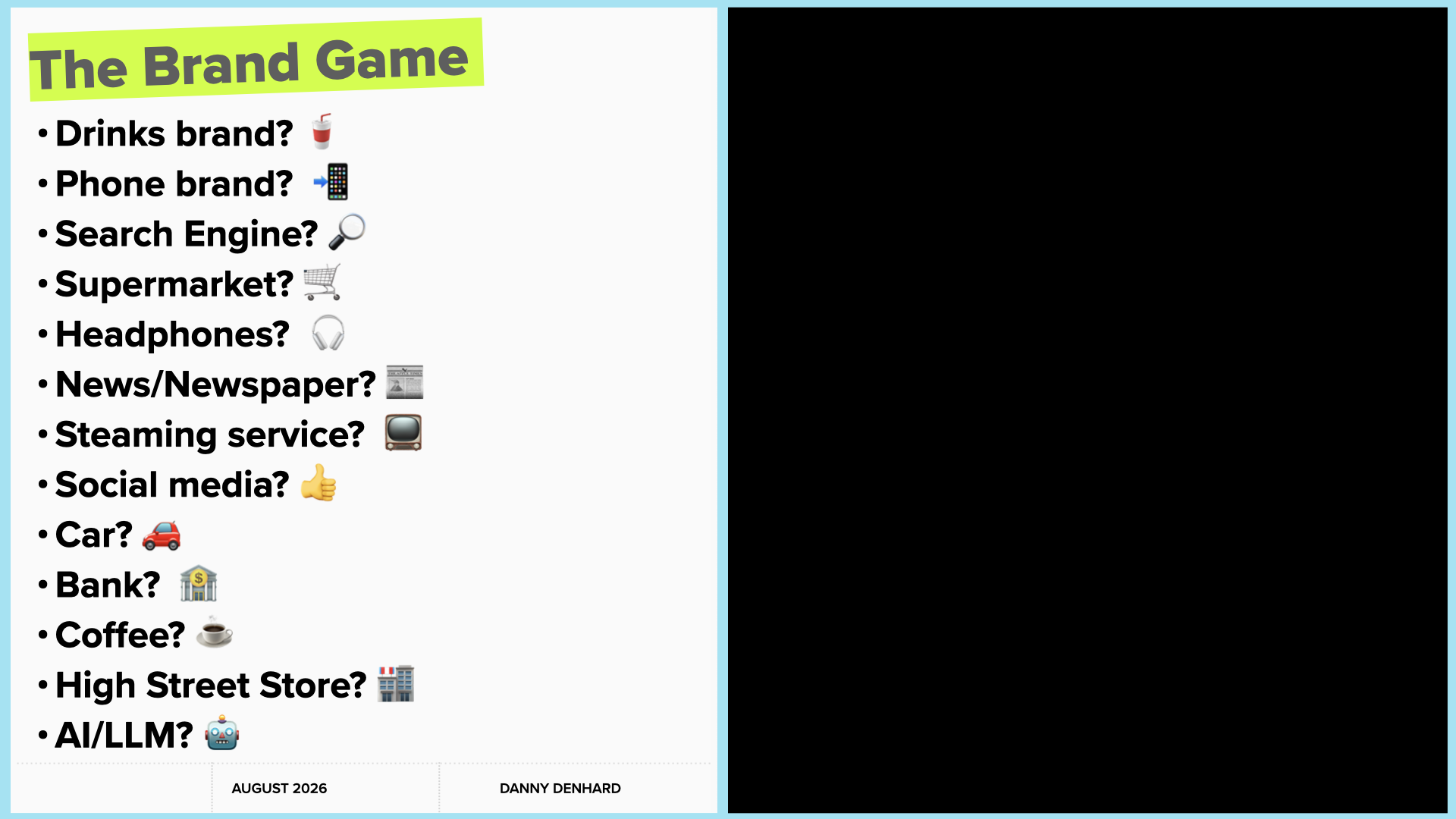
Get your leadership team in a room and work through a simple list of categories. For example:
Drinks or soda
Phone or cell
Search engine
Supermarket
Headphones
News or newspaper
Streaming service
Social media
Car
Bank
Coffee
High street store or mall brand
AI or LLM
Ask people for the first brand that comes to mind in each category. Capture the answers, then pause and look at the patterns.
You will usually see a familiar formula:
Large brand + global influence + heavy advertising + frequent use
= the “winner” in the room
Common traits show up again and again:
Well-known brands with wide distribution
Global or nationally dominant brands
Brands people have used in the last few days
Big advertisers who sit near the top of ad spend tables
Brands that are physically close to the office, like the nearest coffee shop
Tools people use in their work, such as Copilot, ChatGPT or Claude
Younger leadership teams tending to mention more startup brands
Once you have the big obvious brands, push further. Ask for smaller or more local brands in the same categories. This is where you start to hear personal preferences and unfiltered opinions. In most leadership conversations, you rarely get this honesty, but around brands people relax and speak freely.
People remember slogans, sounds, jingles and brand moments. They remember their first bank account, their first iPhone, their favourite old TV ad. Very few can recall precise ad copy from a performance ad. That gap is something you can use. It shows that brand works at a deeper level than a single click.
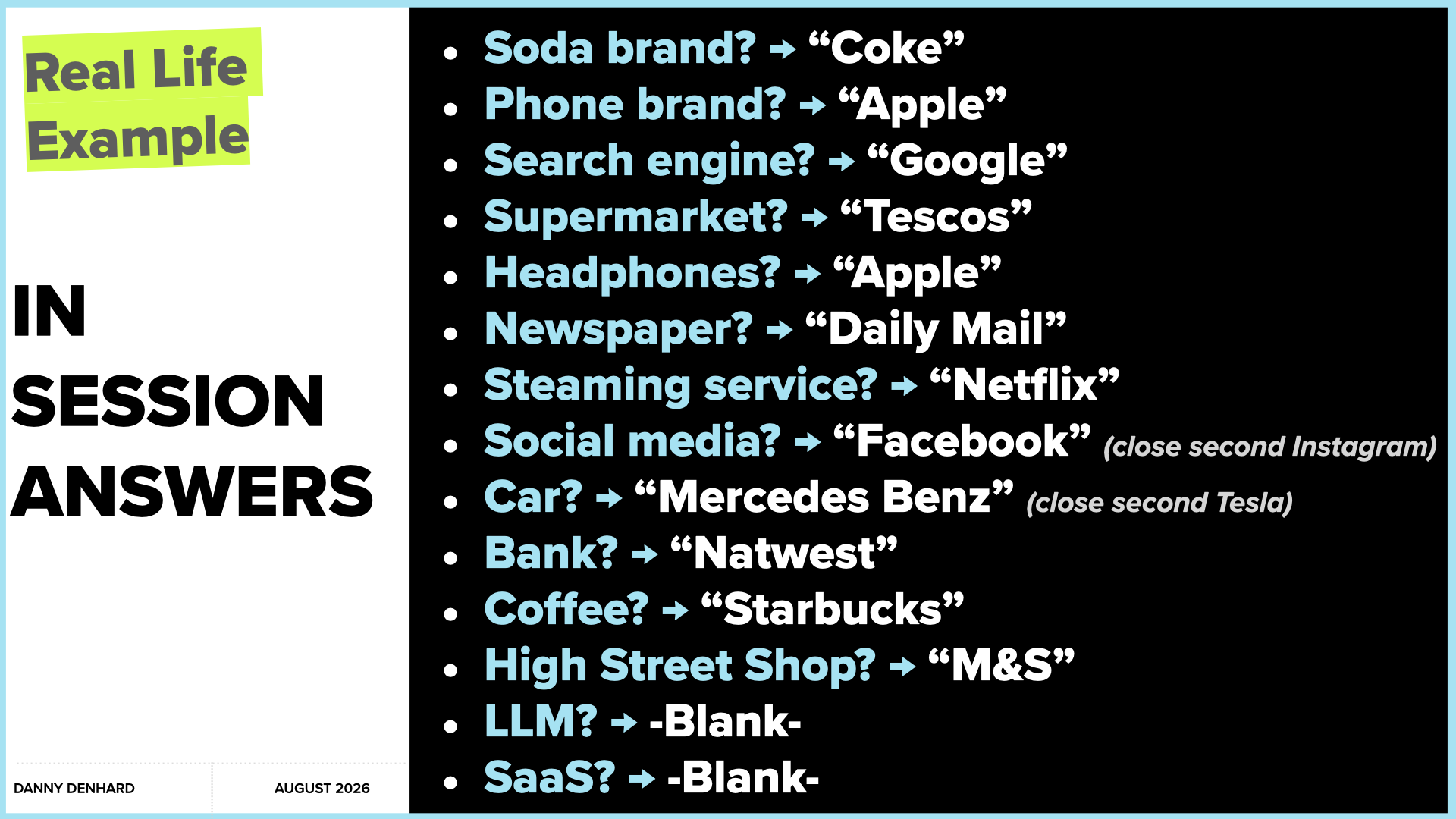
In almost every session, three patterns come up:
Big brands people do not actually like
Starbucks is often named as the coffee brand even when people admit they dislike the product. Reach, consistency, and visibility still win the category.Apple as “the best”
Apple is often called the best in tech and headphones. When you press people, it is often about aspiration and design more than raw technical performance. Android is regularly mocked in non-technical groups. This is a live example of good, better, best positioning and how premium brands lean into it.Mercedes (and Tesla) in cars
Mercedes shows up in almost every group. Tesla appears more when people in the room drive one or have peers who do. Familiarity and status shape the answers.
From here, you can explore colour, brand age, trust levels and where each brand sits on a spectrum from unknown to known, liked to disliked, trusted to hated or loved. Even a short version of this exercise can move the room forward.
Reverse engineer the brands you chose
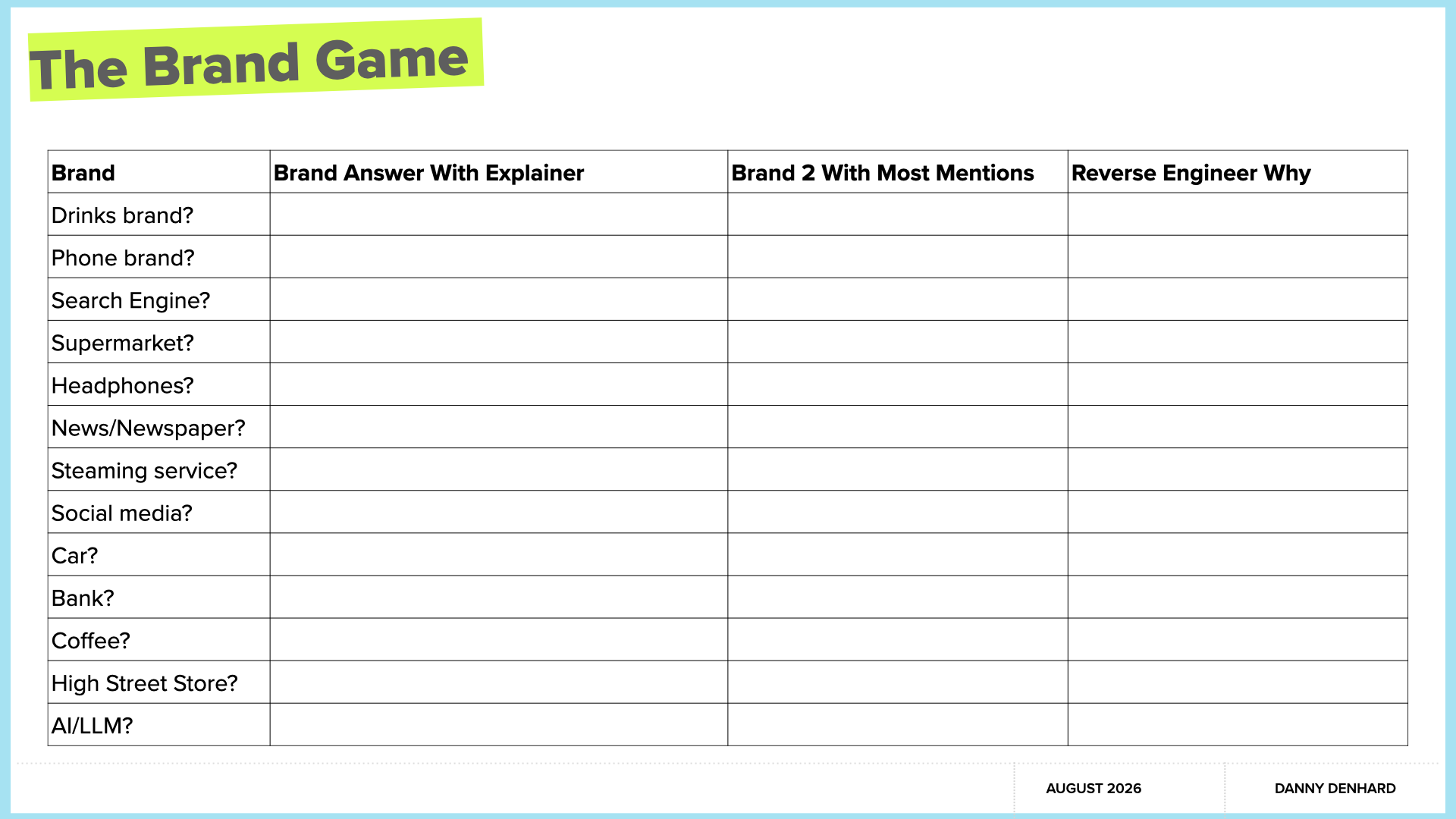
Once the game has surfaced the big brands, move into reverse engineering. Ask the team to pick one or two of the brands they named and break them down.
The goal is to separate the tangible from the intangible. Get people to feel the brand, not just see the logo.
To keep operators like the COO, CRO and CFO engaged, map what you find directly into your company OKRs and commercial goals. Encourage them to think from the ground up instead of only from high-level targets. Show how real work and tactics ladder into those goals.
In one-to-one coaching, this same exercise works well when you pick a brand or campaign that has recently broken through. For example:
Rhode phone case and Meta x Kylie glasses
Guinness “Splitting the G”
On Running, Hoka and Asics in running and lifestyle
ChatGPT versus Claude as first mover versus strong incumbent
Ninja Creami and how Shark and Ninja used TikTok and retail
The rise and then fall of Labubu
You can do the same with SaaS and so-called boring B2B brands. In some ways they are the most useful, because they live closer to your own reality.
Share The Work.
Use slides, Miro, Freeform, pen and paper or a whiteboard. The format does not matter. What matters is making the thinking visible so others can respond and build on it.
Why Reverse Engineering Works
Reverse engineering forces you into the details.
You cannot stay at the level of “great creative” or “big budget.” You have to ask:
What decisions did they make at each stage
What were the real drivers of adoption
How much came from product, how much from marketing
Where did culture, social and search play a role
How much was craft and how much was luck
You should structure the exercise around:
The 4C’s: Consumer, Cost, Convenience, Communication
Compared with the 4P’s: Product, Price, Place, Promotion
Distribution, amplification and operations
Timelines so you can see how long it actually took
The digital layer is relatively easy to inspect. You can look at ad libraries, emails, the purchase flow and social feeds. The harder, more valuable part is the leadership layer.
Why did they choose that pricing, that launch channel, that sequence, that positioning?
The point is not to be perfectly right. It is to build a shared model of how brands grow and to see how many choices are deliberate and how many are situational. That perspective alone can change how your team plans and reports.
Turn This Into A Ritual
This is not a one-off party trick. It works best as a recurring habit.
Recommended cadence:
One quarterly session with your marketing team
At least one session with your leadership team
A session with your CPO or product leadership, especially if competitors’ brands are always mentioned internally
In a world of constant reforecasting, headcount pressure and demands for more output, this kind of deep work is a reset. Two to three hours of structured brand thinking can reframe how people see your own brand and the trade-off between brand and performance.
Need Help?
If you do not feel ready to run this yourself in an ELT or SLT forum, you can bring me in as a facilitator; drop me an email coach@dannydenhard.com.
The invitation is simple.
Use the brand game and reverse engineering exercises to build respect for the brand, then use the list of ten to clean out lazy habits that hold your marketing back.
The 4 Actions To Take
Run the Brand Game with your leadership team. Go through the category list (drinks, phone, search engine, supermarket, AI/LLM, etc.), get everyone to say the first brand that comes to mind, then discuss why those brands “won” (size, frequency, advertising, proximity, job relevance).
Reverse engineer 1–2 of those “winning” brands or campaigns. Break down what made them work: product, positioning (good/better/best), distribution, amplification, timelines, culture, luck, and how they map to your OKRs and goals (especially for COO/CFO/CRO types).
Run a focused reverse‑engineering session on a recent standout brand/campaign. For example: Rhode phone case, Meta x Kylie glasses, On/Hoka/Asics, ChatGPT vs Claude, Ninja Creami, or even a “boring” B2B SaaS in your space, and document the 4C’s vs 4P’s and the go‑to‑market decisions.
Turn this into a quarterly workshop for your team and at least one session with your C‑suite. Use slides, Miro, Freeform, pen and paper or a whiteboard, but make it a recurring ritual to reset how everyone thinks about brand vs performance and investment.
Go Share With Your Team:
If you think this would help your own leadership team or department, you can share - https://www.marketingunfiltered.co/p/101.
